The UK’s Court of Appeal upheld the British government’s proscription of Palestine Action as a terrorist organisation. Chief Justice Sue Carr ruled the group was not the civil disobedience outfit it claimed to be, and that its ban “struck a fair balance.”
We want to be clear about what that balance looks like in practice, as the UK’s Labour government has used the ruling to push forward with the largest suppression of voting seen in the country in recent history.
Since Palestine Action was proscribed under the Terrorism Act 2000 last July, more than 3,300 people have been arrested across the UK. Of those, more than 1,200 have been charged with terror-related offences. The average age of those arrested is 57, a number skewed by the number of elderly people represented at Palestine Action protests in the country.
They are 4.4 times more likely to be female than the typical terrorism suspect. In the months before the ban, between April and June 2025, UK counter-terrorism police made 63 terrorism arrests. In the three months after, they made 1,706. That is a 2,608 percent increase.
Year on year, terrorism arrests are up 660 percent. Eighty-six percent of all terrorism arrests in the UK last year were linked to Palestine Action. A government that sells weapons to a state committing genocide, and allows its has run reconnaissance flights for that same genocidal nation, just happens to be squashing Palestinian protest, coincidence on that level is rarely ever real.
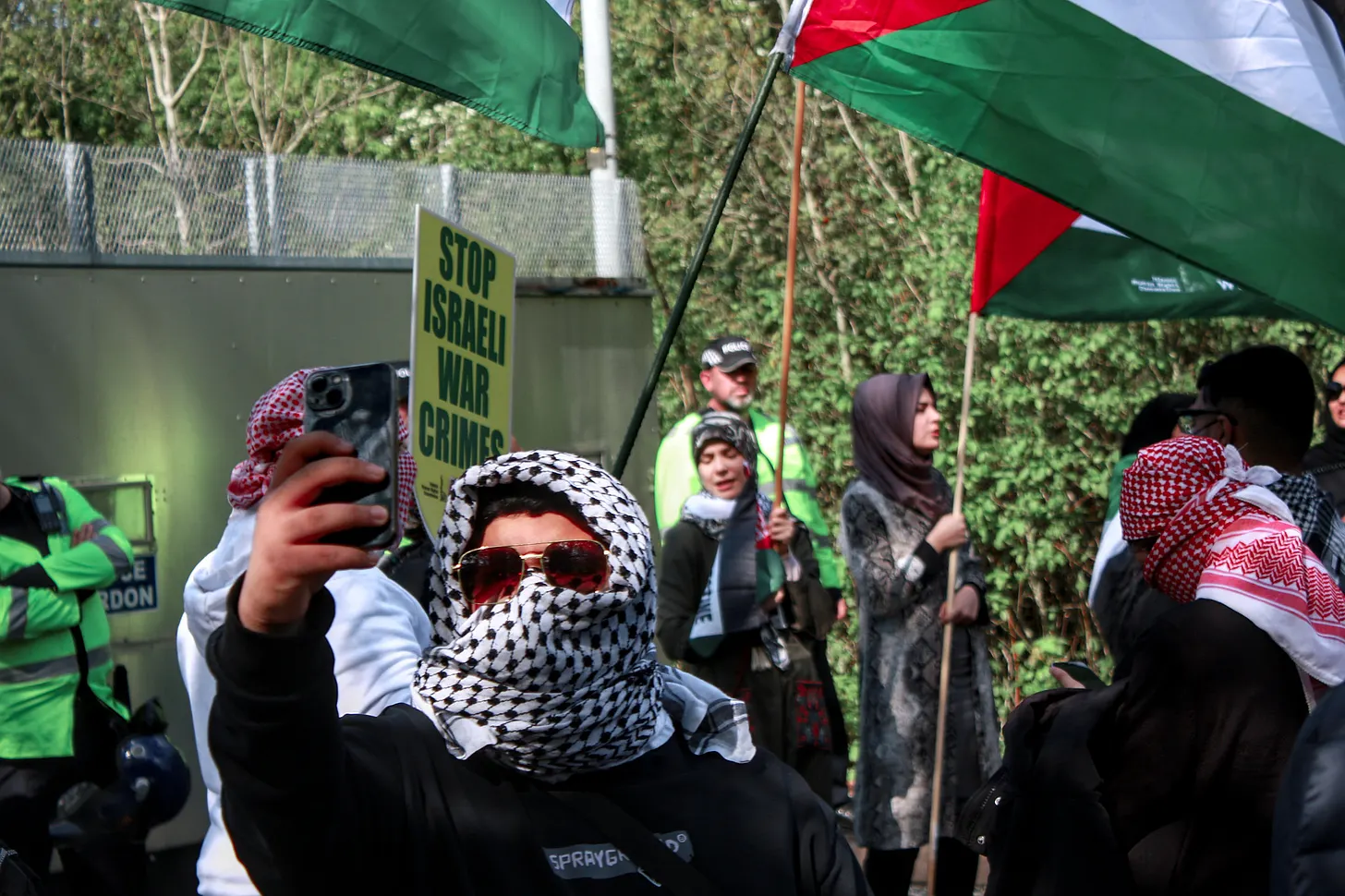
These arrests are not linked to Palestine Action members. They are linked to people who support Palestine Action. People who stood in Trafalgar Square holding cardboard signs reading “I oppose genocide. I support Palestine Action.”
In April, 523 people were arrested at a single vigil, ages 27 to 82, removed by officers one by one, including an elderly woman on walking sticks and a man in a wheelchair, for holding those signs. A Baptist minister was arrested in Oxford for sitting in a town square with a placard. An 83-year-old retired priest was arrested hours after the ban came into force. One woman, being led to a police van, said what everyone watching already knew: “I’m being arrested for holding a cardboard sign, whereas our government feels the need to sell weapons and use our airbases to commit genocide in Palestine.”
And we should be precise about who built it. Keir Starmer came to power describing himself as a socialist, pledging to keep the “radical socialist tradition” at the heart of Labour. He took a knee for Black Lives Matter. He presented himself, and his party presented itself, as a corrective to fourteen years of Conservative authoritarianism.
Within a year of taking office, his Home Secretary had placed a protest group on the same legal footing as al-Qaeda, and his government fought two rounds of legal challenge to keep it there. When the High Court ruled the ban disproportionate in February, finding it caused “a very significant interference with the right to freedom of speech and free assembly”, Starmer’s government appealed. Today they won.
It’s clear at this point that this was never really about Palestine Action. The group’s actual direct actions -- spray-painting jet engines at RAF Brize Norton, smashing equipment at Elbit Systems factories -- were always separately prosecutable as criminal damage. The High Court said so explicitly. What the proscription added, and what today’s ruling preserves, is the criminalisation of expressed support. Of signs. Of vigils. Of saying, out loud, in a public square, that you oppose a genocide and support those trying to stop it.
The Filton Four, Charlotte Head, Samuel Corner, Leona Kamio, and Fatema Rajwani, were convicted by a jury of criminal damage. No jury found them guilty of terrorism. A judge applied the label at sentencing anyway, in what Middle East Eye confirms is the first time in UK legal history that protesters convicted of criminal damage have received a terrorism finding upon sentencing. They received between four and eight years. Seventy-two people were arrested outside the court while that verdict was being read, for holding signs.
A barrister involved in the case said it plainly: “The only cases they’re really keeping in the criminal courts by pursuing this appeal are the 3,000 grannies standing with placards awaiting trial on terrorism charges. They need to explain the pursuit of 3,000 grannies with placards to the taxpayer.”
They won’t. Because the pursuit isn’t a bug. The 660 percent surge in terrorism arrests isn’t administrative overflow from a broad proscription. It is the point. A government that calls itself progressive has built the most expansive domestic terrorism enforcement operation in modern UK history, aimed primarily at middle-aged women with cardboard signs, and today its highest court told it that this is lawful.
Palestine Action co-founder Huda Ammori says the group will fight the ruling to the Supreme Court and the European Court of Human Rights. Because what is being normalised here, the casual terrorism-branding of dissent, the mass arrest of vigil-holders, the judicial relabelling of criminal damage as terror is all too familiar when compared to other regimes who have squashed descent.