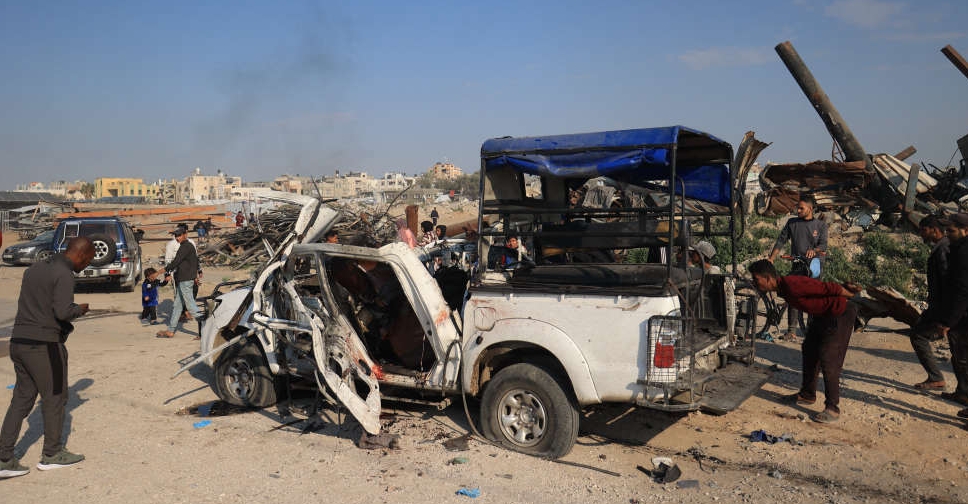
On the morning of 24 April, officers from Gaza's interior ministry responded to a fight in Khan Younis. By the time their police vehicle arrived, the dispute had been broken up, then an Israeli munition struck their vehicle. Eight people were killed, including four civilian bystanders, including a 9-year-old child, who had nothing to do with the original altercation or the policing of it.
A few hours later, a separate strike in Gaza City killed two more officers. A third attack flattened a house in Beit Lahiya, killing two. Twelve dead in a single day, six months into a ceasefire that was supposed to end this kind of arithmetic. Over 1,000 have been killed during the so-called "ceasefire", as it seems Israel doesn't feel the agreement they signed applies to them. Gaza's media office now counts more than 3,689 ceasefire violations.
That was not the end of it. On 6 May, Colonel Naseem al-Kalazani, a senior Interior Ministry officer, was killed in a targeted strike on his vehicle near al-Mawasi, wounding at least 17 others. On 23 May, two missiles hit a police post in the Al-Tawam area of northern Gaza, killing five officers and a 13-year-old boy. On 14 July, a strike on a police post in Jabaliya's Faluja quarter killed Colonel Mohammad Marwan Salem, head of the Jabalia police force, five other officers, and a woman nearby. Israel said Salem commanded a Hamas "central Jabalia battalion" and that four of the dead were militants; it produced no evidence.
The Gaza Interior Ministry called on the international community to intervene and said continued silence over the targeting of police officers amounts to complicity. The international community, predictably, did not respond. Most of the English-language press did not report on the repeated assaults on police officers in the Strip.
It is clear that this is not a series of isolated incidents, this is a systematic targeting campaign.
Since the US-brokered ceasefire took effect on 10 October 2025, Israeli strikes have killed dozens of officers from Gaza's civilian police force in operations whose timing, location, and targeting pattern admit only one conclusion: the dismantling of Gaza's civil-order apparatus is the objective.
On 14 December 2025, Lt Col Ahmed Zamzam, a senior officer in Gaza's internal security service tasked with countering Israeli collaboration networks, was shot dead in Maghazi refugee camp by gunmen the interior ministry said were operating on Israeli orders. The leader of the Israeli-armed Popular Forces militia, Ghassan Duhine, later claimed credit. A captured operative reportedly told investigators that an Israeli intelligence officer had supplied the cell with silenced pistols, electric bikes, and target coordinates because Zamzam's security file threatened to expose Israel's collaborator network in Gaza.
On 12 January, Khan Younis police chief Lt Col Mahmoud Al-Astal was killed in al-Mawasi by gunmen from a vehicle that fled the scene; the interior ministry attributed the killing to agents of the occupation. On 31 January, an airstrike on Sheikh Radwan police station in Gaza City killed at least sixteen people, including five officers ranked from lieutenant to colonel. On 27 February, coordinated drone strikes hit two police posts in al-Mawasi and Bureij, killing six. On 15 March, nine officers in a single police vehicle were killed by a targeted strike while monitoring Ramadan markets. On 11 April, six died at a police checkpoint at the entrance to Bureij refugee camp, among them a journalist named Mohammad Sayyed. On 13 April, four young officers were killed at a Deir al-Balah police post. On 14 April, a strike on a police vehicle in Gaza City killed four, including three-year-old Yahya al-Malahi. Then there was the strike on 24 April.
Reuters acknowledged the pattern in wire copy. On 3 June, OHCHR went further: since January 2026, it had recorded at least twelve attacks against police, killing at least 53 civilians including 35 police personnel, five boys, and one woman. Four attacks in May alone killed twelve officers. The UN office said the pattern raises concerns that Israeli forces apply "no distinction" between police personnel and fighters, and that attacks on officers performing ordinary law enforcement functions "would amount to war crimes." The BBC, the New York Times, the Guardian, and the major U.S. broadcast networks have still not framed it as a campaign.
In June 2025, Prime Minister Benjamin Netanyahu publicly confirmed that Israel had begun arming criminal gangs in Gaza, presenting the operation as a measure to weaken Hamas. Defence officials confirmed that Kalashnikov rifles, some seized from Hamas during the war, were being transferred to a militia led by Yasser Abu Shabab, a convicted drug trafficker who escaped prison during the early bombardment of Gaza in October 2023. The head of UN OCHA, Jonathan Whittall, has stated that gangs of this kind are responsible for the systematic theft of humanitarian aid throughout the war, and that the looting takes place under Israeli military observation. Abu Shabab was killed in December 2025; his deputy Ghassan Duhine took over the Popular Forces and continues to operate under the same arrangement.
Gaza's civilian police force has been the principal body attempting to suppress these groups. An officer named Asaad al-Kafarna was killed by Israeli forces in May 2025 while pursuing armed looters working with the Israeli military. Zamzam was killed in December because his counter-collaboration work threatened Israel's gang network. The officers killed in al-Mawasi on 27 February were stationed, the Al Jazeera correspondent on the ground noted, at checkpoints deployed too close to areas where armed militias were operating. The pattern is not random and it is not collateral. Israel arms the gangs that loot the aid; Israel kills the officers who try to stop them.
There is no legal basis for these attacks, as the UN Fact-Finding Mission on the Gaza Conflict laid out in 2009, the rule is that members of law-enforcement agencies are part of the civilian population unless they have been incorporated into the armed forces of a party to the conflict, and, the Mission noted, this principle is accepted by the Israeli Government. There are three exceptions: incorporation of the police force into the armed forces, simultaneous membership in an armed group, or direct participation in hostilities at the moment of the strike. None of those exceptions covers an officer responding to a market dispute, monitoring Ramadan stalls, or sitting in a marked police vehicle. The same Mission applied this framework to Israel's killing of ninety-nine Gaza police officers during Operation Cast Lead and concluded the strikes were unlawful. The framework has not changed. The factual posture is, if anything, cleaner now, because the strikes are taking place during a declared ceasefire and frequently in zones outside Israeli military deployment.
The Fourth Geneva Convention, which applies in full because Gaza remains occupied territory under the International Court of Justice's July 2024 Advisory Opinion, prohibits the wilful killing of protected persons as a grave breach under Article 147. Grave breaches carry universal jurisdiction. The Rome Statute classifies intentional attacks against civilians not directly participating in hostilities as war crimes. The Hague Regulations require an occupying power to restore and ensure public order — a duty that becomes a legal absurdity when the same occupying power is killing the civilian officers attempting to discharge it.
UN Human Rights Chief Volker Türk said in April that the unrelenting pattern of killings in Gaza reflects Israel's sweeping impunity. The phrase landed and disappeared. The strikes did not. They continued through June and now into July. The UN has now said what we said in April. The wider press has still not.
What is happening in Gaza is the deliberate dismantling of the civil-order architecture of an occupied population while the occupier simultaneously arms the criminal networks that fill the vacuum. It is being conducted in plain sight and within a ceasefire framework that the United States continues to characterise as holding. The Gaza Interior Ministry has called it complicity. The legal term is grave breach. The English-speaking press has, for the most part, called it nothing at all.