Israeli soldiers shot dead a disabled man in the village of Jamla in southern Syria on 22 October, firing from snipers posted on rooftops, according to Syria's state news agency. Six days later, troops raided a home in Saida al-Jolan in Quneitra, took a man away and then shelled the farmland on the edge of the village. Bulldozers are tearing up olive groves in the middle of the harvest to extend a military road, trench and earth wall that Israel is building through Syrian farmland.
This is the Israeli invasion of Syria, now nearly two years old, and it has all but vanished from the headlines. Almost everything known about it reaches the outside world through Syria's state media, regional outlets, local monitors and the occasional UN briefing in Geneva. The governments that could stop it have said next to nothing. The UN human rights office counted about 280 incursions by Israeli forces into Syria in September, the highest monthly figure this year.
Israel invaded on 8 December 2024, the day Bashar al-Assad fell. Benjamin Netanyahu ordered troops into the 400 square kilometre demilitarised zone set up between the two countries in 1974, and the army took the Syrian side of Mount Hermon. Netanyahu stood on the mountain nine days later and said his forces would stay "until another arrangement is found that will ensure Israel's security". In September this year he claimed "absolute control" of an area running from Mount Hermon to the Yarmouk River.
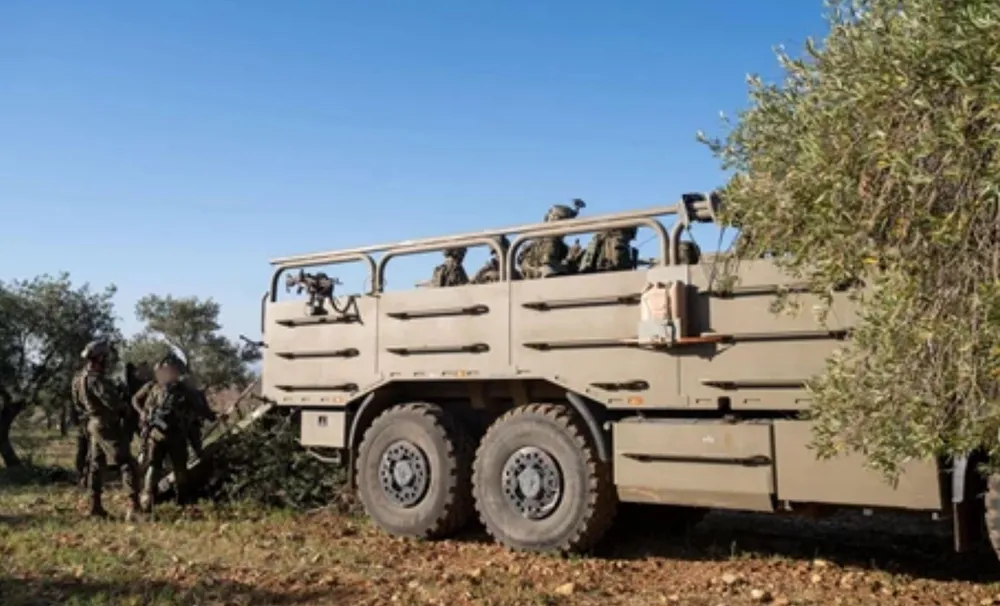
The army never left the zone, and it never stayed inside it. The UN Secretary-General's latest report says Israel has maintained and reinforced 11 positions on the Syrian side, and its troops use them for near-daily raids into Quneitra and Daraa. They set up checkpoints, search phones, detain shepherds and farmers, and close roads around their positions. The barrier, which Israel calls Sufa 53, has been pushed south through Quneitra province. On 18 October troops bulldozed about 1.3 hectares of olive trees near Saida and kept farmers from the rest of their fields, Anadolu reported.
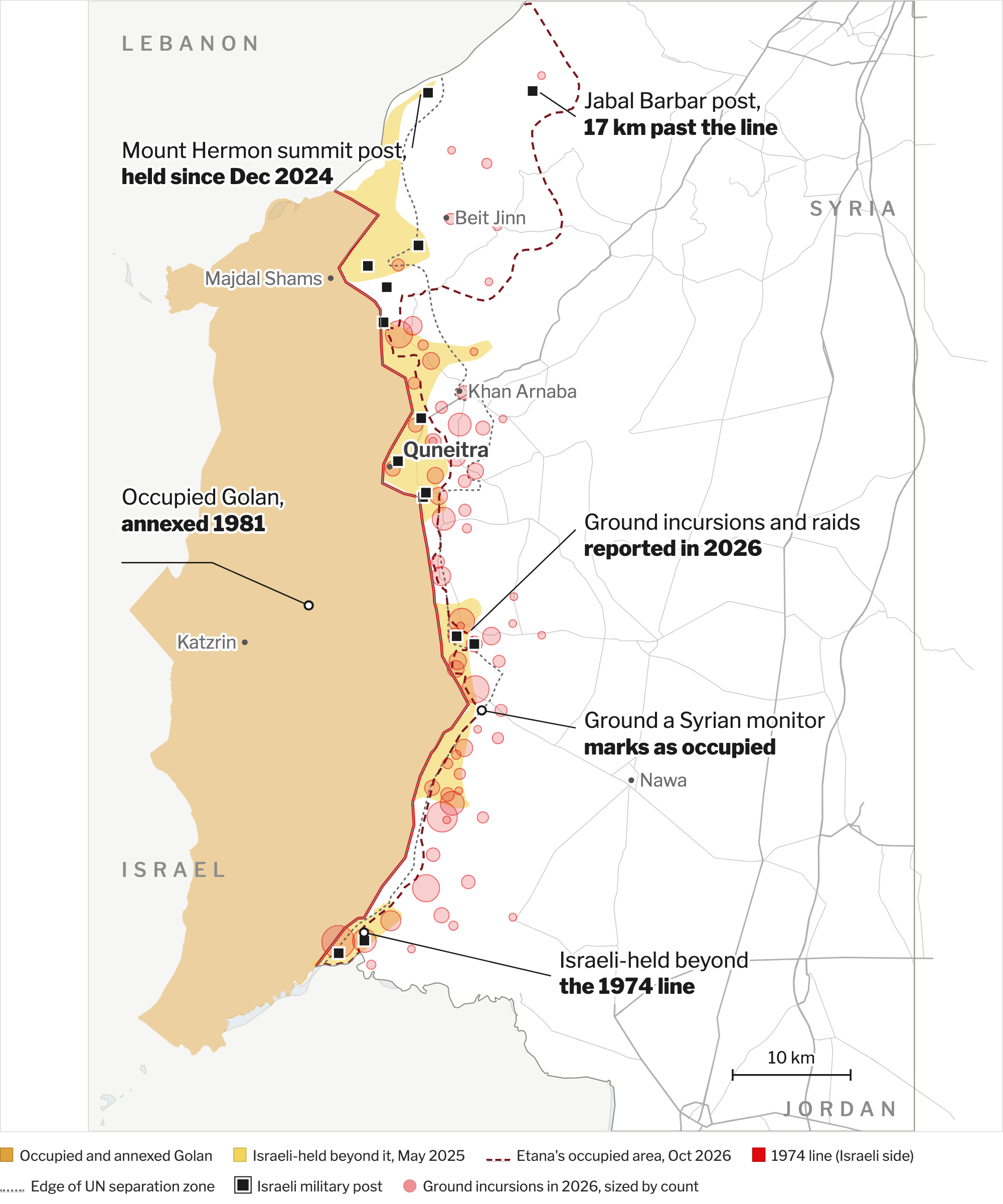
At least 49 Syrians are believed to be held by Israel, the UN human rights office said on 9 October, some for over a year, with no reason given, moved to facilities their families do not know. Former detainees describe beatings, being forced to stand for hours, threats against their families and dogs being set on them. A 22-year-old man from Jaba was shot dead near Israeli positions at Al-Hamidiyah in early October while walking at night, with no known warning shots, and the UN's human rights chief, Volker Türk, has called for an investigation. The same week, a farmer with a disability was shot in the leg in northern Quneitra and detained while he bled.
The deadliest raid came in November 2025, when Israeli troops went into Beit Jinn at night to arrest men they called militants and killed at least 13 people, according to Syrian officials. In July 2025 Israel bombed the Syrian defence ministry in Damascus and an area near the presidential palace, saying it was protecting the Druze of Sweida. Syria's president, Ahmed al-Sharaa, told the UN General Assembly in September that Israel had carried out 500 airstrikes, more than 1,200 incursions and 300 detentions since his government took power. Syria has not fired back once.
Israel's reach goes well beyond its soldiers on the ground. In August 2025 Syrian troops near Kisweh, south of Damascus, found what state media called "surveillance and eavesdropping devices". Israeli strikes on the site then killed six soldiers and Israeli troops raided it. An Israeli official later told a Saudi channel the devices were Turkish. Three months earlier the Mossad had taken the entire Syrian intelligence archive on Eli Cohen, the Israeli spy Syria hanged in 1965, out of the country in what Netanyahu's office called a covert operation.
Syria's own arsenal keeps blowing up. Reuters has counted at least 16 explosions at Syrian arms stores since December 2024. One in Idlib in September killed 14 people and another in the east killed 11. Syrian authorities are examining whether Israel was involved, according to Israel's Kan and i24 News, but Damascus has not blamed Israel and analysts say there is no hard evidence either way. Another depot exploded in Idlib on 26 October.
The United States, which brokers the talks between the two countries, has blocked the UN Security Council from naming Israel. When members pushed in August 2025 to condemn Israeli military action in Syria, the US resisted any direct reference to Israel. The Council renewed the UN force on the line in June with a short, unanimous text that left Israel's occupation unaddressed. Washington's envoy, Tom Barrack, called an Israeli strike an "unnecessary escalation" in August only because it hit an airbase in the north where Turkey, an American ally, was said to be deploying. The raids on Syrian villages drew no such words.
Europe has done less. An EU spokesperson told Syria's state news agency in August that Israel should respect the buffer zone and the 1974 agreement, and that was the extent of it. When Russia seized land in Ukraine, the EU and the United States answered within days with sanctions, and they have added to them ever since. Israel has faced no sanctions for taking land in Syria. Colombia went the other way in August and recognised Israeli sovereignty over the Golan Heights, the second country to do so after the United States.
Israel's defence minister, Israel Katz, said in July that the army would stay in its security zones in Lebanon, Syria and Gaza until further notice. Netanyahu has made the price of any deal the demilitarisation of the whole south of the country, an area reaching about 30 miles towards Damascus, far deeper than the zone agreed in 1974. Al-Sharaa said in New York that the two sides had "almost reached 90% of agreements" before Israel pulled back and added conditions.
The raids are so routine that residents of Beit Jinn say they come almost daily, and young men stay away from their own fields for fear of being taken. We have mapped the ground Israel holds in Syria, alongside Gaza, the West Bank and southern Lebanon, on our What Israel Controls page, and set out the full picture in Mapping All Territory Illegally Held by Israel. Israel has now held Syrian land beyond the Golan Heights for almost two years without a single government making it pay.