The ceasefire that took effect in Gaza at noon on 10 October 2025 ended Israel's large-scale bombardment. It did not end the killing. Since that day Israeli forces have killed at least 1,460 Palestinians and wounded 5,116, according to the latest Gaza Ministry of Health figures reported by Al Jazeera on 7 October and by AFP the same day. That is about four people a day for a year of what is officially a truce. On the anniversary itself Israeli strikes killed at least five more people, four of them near Panda Mall in Gaza City, medics told Reuters. More than 100 humanitarian and human rights organisations said in a joint statement on Friday that the ceasefire exists in name only.
Those deaths sit on top of a genocide that has killed 74,254 Palestinians, 20,179 of them children, according to the ministry's figures via Tech for Palestine as of 8 October. Our live Gaza record tracks the count.
The attacks have been close to daily. An Al Jazeera analysis found Israel attacked Gaza on 325 of the past 361 days, leaving 36 days with no reported attack, death or injury. UN OCHA, citing the ministry, counted 1,431 killed and 5,026 injured by 30 September, 29 of them in the last week of September alone.
More than 300 of those killed since the ceasefire were children, the ministry says, the BBC reported. The BBC notes the UN considers the ministry's figures reliable. Israel says it is targeting Hamas operatives and accuses Hamas of violating the truce. At least seven Israeli soldiers have been killed in Gaza over the same year.
When the deal was signed, Israeli forces held about 53 percent of Gaza behind what became known as the "yellow line", Middle East Eye reported. Later phases were supposed to bring further withdrawals. Instead the line moved west. By May Israel controlled about 64 percent, and Prime Minister Benjamin Netanyahu said he had directed the army to take 70 percent, according to the BBC. OCHA now reports restrictions on access to 65 percent of Gaza's land, with the remaining 35 percent "already overcrowded". Palestinians who approach the line have been shot dead. Israel is also building a wall inside Gaza.
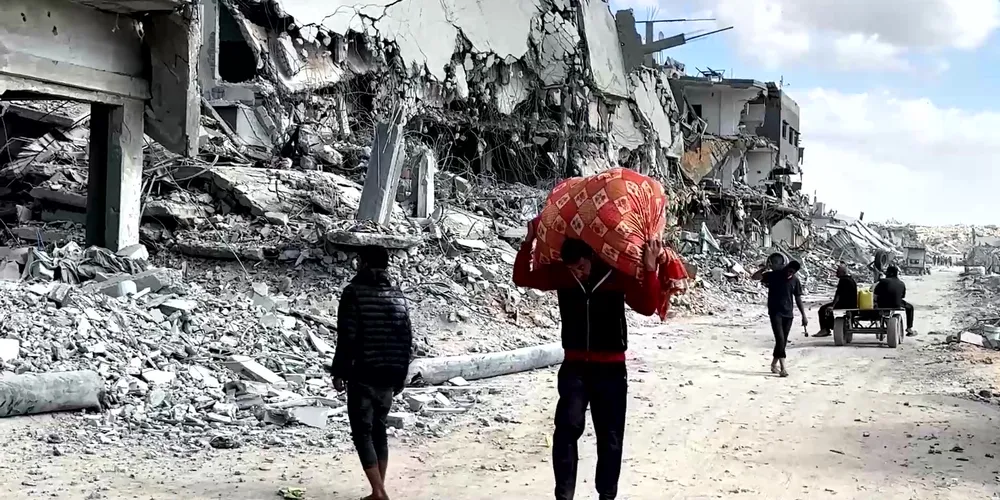
The destruction has continued too. The UN Satellite Centre found destroyed structures across Gaza rose by 9 percent after the ceasefire took effect. A New York Times analysis found Israel demolished more than 2,500 buildings in the first three months of the truce, Middle East Eye reported.
The agreement required Israel to allow up to 600 trucks a day carrying food, fuel, medical supplies, shelter materials and commercial goods, according to Middle East Eye. Gaza's government media office said deliveries through April ran at about a quarter of that. Israel now says more than 600 trucks enter each day, the Guardian reported.
UN agencies describe a narrow and unreliable pipe. Kerem Shalom has been the only working cargo crossing since Israel closed Zikim on 24 May, and Israeli limits on engine oil, spare parts and equipment have pushed southern Gaza's two desalination plants to their lowest output, OCHA says. At least four other main entry points remain closed, and almost two million people need shelter against the coming cold, WHO says.
Reconstruction has not started. The US-led Board of Peace, whose executive board includes Jared Kushner, proposed a $2.45 billion first phase in September. Full recovery could cost $71.4 billion over a decade, ABC News reported. The board says building would begin in 2027 "as the demilitarisation progresses".
The board and Netanyahu tie reconstruction to Hamas disarming. Hamas agreed to a disarmament framework in July but links it to an Israeli withdrawal that has not happened. Kushner has acknowledged "different delays on different things". Meanwhile nearly two-thirds of Gaza's people live in tents or makeshift shelters, ABC reported.
Hamas returned all 48 remaining hostages under the first phase, the BBC reported. Israel's side of the deal has not been met. It promised to halt hostilities, and has killed at least 1,460 people. It agreed to freeze its lines, and has moved them. It agreed to up to 600 aid trucks a day, while the UN reports a single cargo crossing and blocked equipment. It agreed to open Rafah to free movement, and Gaza's media office says only about a quarter of agreed crossings took place between February and April, per Middle East Eye.
A year on, the ceasefire has slowed the killing. It has not stopped it, and it has not returned Gaza to the people who live there.