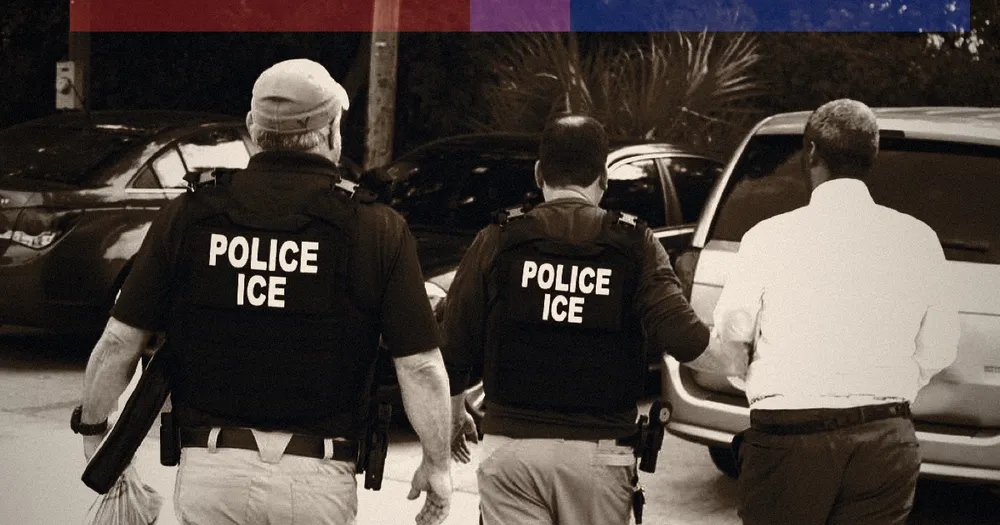
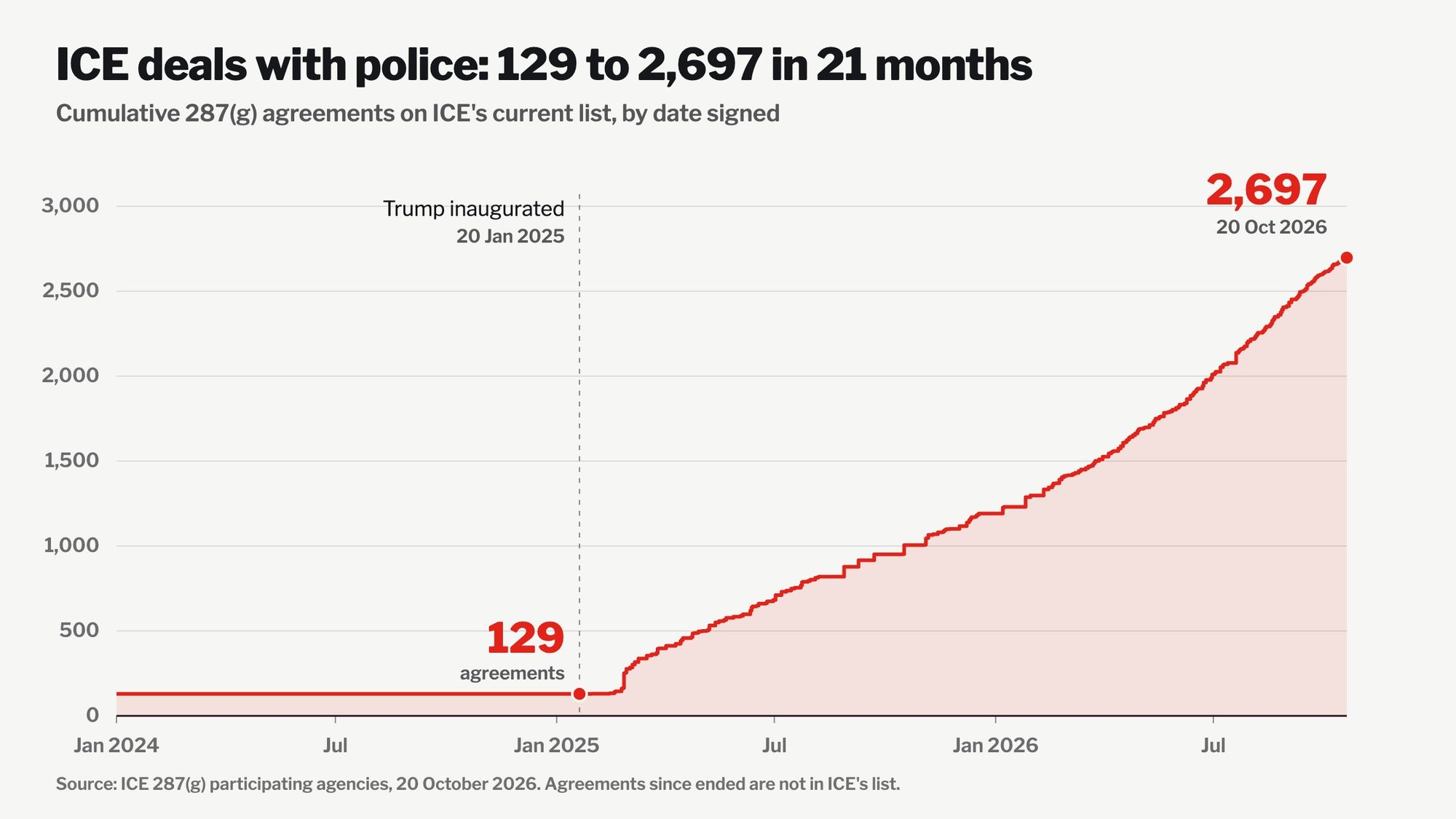
The number of police departments and sheriff's offices signed up to do ICE's work has not slowed since we last counted it in June. ICE's own list, updated on 21 October, shows 2,698 287(g) agreements across 38 states and two territories. On the day Donald Trump was sworn in for his second term, 129 of them existed. That is an increase of 1,991%, more than twentyfold, in 21 months.
We counted it the same way as our June analysis: we took ICE's current spreadsheet and counted every agreement signed on or before 20 January 2025. Agreements that have since ended drop off ICE's list, so the real figure on inauguration day was slightly higher, about 135 by ICE's own earlier accounts. Even from that base, the rise is more than 1,800%. In June the list held 1,987 agreements. Since then ICE has been adding them at roughly 200 a month, and 769 of the agreements on today's list were signed after our first piece ran.
287(g) comes in three forms. Under the Jail Enforcement Model, of which there are 182, deputised jailers screen people already booked into a county jail. Under the Warrant Service Officer model, 574 agreements, officers serve ICE's own administrative warrants on people in their custody. The third is the one that matters most. The Task Force Model, 1,942 agreements and 72% of the total, puts deputised officers on the street, free to question and arrest people on suspicion of an immigration violation in the middle of ordinary policing. Not one task force agreement on ICE's list predates 20 January 2025. All of them were signed under Trump.
That model was shut down once, for good reason. In 2011 the Justice Department found that Sheriff Joe Arpaio's deputies in Maricopa County, Arizona, had run sweeps through Latino neighbourhoods and stopped Latino drivers at many times the rate of everyone else. Homeland Security ended Arpaio's agreement and let the task force model lapse in 2012. The Trump administration brought it back in 2025 and has now signed more than 1,900 task force agreements.
It has also hollowed out the preparation. Internal emails reported by the Washington Post show ICE cut the task force course from four weeks of in-person instruction to a 40-hour online class, removing field scenarios and trimming instruction on nationality law, the part that tells an officer who is and is not a citizen. In August ICE offered to help pay for personal liability insurance for deputised officers, who are being sent out with less training and more legal exposure.
Texas leads with 555 agreements, followed by Florida with 354, Arkansas with 179, Tennessee with 163 and Missouri with 161. Some of that is compulsion. Texas's SB 8 requires every sheriff who runs a jail to request an agreement by 1 December, and a Tennessee law in force since 1 July tells every sheriff to sign by 1 January or risk state funding. Arkansas has no mandate and has signed up anyway: the Arkansas Democrat-Gazette counted task force partners there rising from 13 to 98 in a year, and ICE's list now shows 123 task force agreements in the state.
Other states have gone the other way. California, Connecticut, Delaware, Illinois, Maine, Maryland, New Jersey, New Mexico, Oregon and Washington ban the agreements by law. New York joined them when its ban took effect on 25 August. Fifteen sheriffs, led by Rensselaer County's, are suing to keep working with ICE, and Attorney General Letitia James has sued Rensselaer, whose jail agreement from 2020 is still on ICE's list. Massachusetts now bars new agreements. New Mexico's attorney general is suing two county sheriffs, in Curry and Torrance, who are still listed despite the state's ban.
Virginia shows how far the administration will go to keep the pipeline open. Its new law banned new agreements and attached conditions to existing ones, among them no immigration enforcement at schools, places of worship, courthouses or polling places, and a judge's warrant to enter a home. The Justice Department sued, and on 31 August Senior US District Judge Robert Payne blocked the conditions, finding the federal government likely to win under the Constitution's Contract and Supremacy clauses. The ban on new agreements still stands. Virginia's 22 existing agreements, most of them task force deals, carry on without the limits.
The reason ICE wants local police is arithmetic. ICE leaders have told agents to arrest 1,000 more people a day, reviving a target of 3,000 arrests a day. Its own officers cannot be everywhere. Thousands of deputised police, stopping drivers and checking papers, give it reach into towns where ICE has never had an office. The people they hand over go into a detention system where hearings come late, lawyers are hard to reach, and people are pushed to sign away their claims. When due process is removed, those are concentration camps, and local police are now one of the main roads in.
Every one of those 2,698 agreements is a local choice to turn officers against the people they are paid to protect. The line on the chart has not bent since June. It has steepened.
Democrats won both houses of Congress on 3 November and take control on 3 January, but they cannot cancel these agreements by themselves. Much of the money Republicans gave ICE in 2025 is available through 2029, and a bill to take it back would face Trump’s veto. What a Democratic Congress can do is put the officials who signed the deals under oath, and Bennie Thompson, the top Democrat on the Homeland Security Committee, has already told DHS to keep every record it holds. The agreements are signed and ended locally, so whether this line bends depends as much on sheriffs, councils and state legislatures as on Washington.