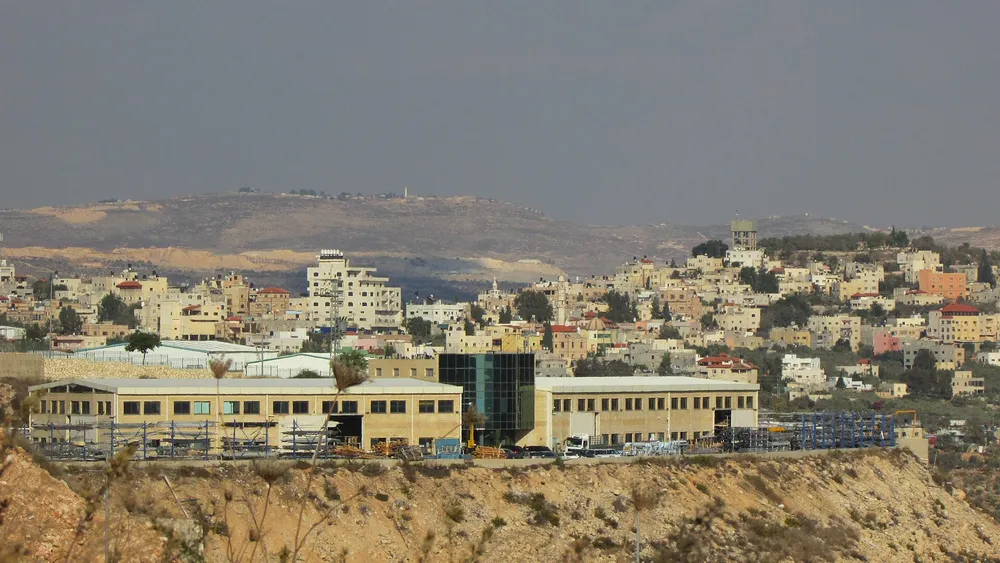
Israel runs 28 settlement industrial zones on 8,844 dunams (about 884 hectares) of the occupied West Bank and is now driving a new wave of them towards the Green Line, the Palestinian Colonization and Wall Resistance Commission found in a paper published on Saturday. The Civil Administration, the arm of the Israeli military that governs the occupied territory, holds a further 35,258 dunams in reserve for industry, four times the area already built on. The commission called it the largest wave of settlement industry in years.
Avi Bluth, the head of the Israeli army's Central Command, signed an order this month fixing the boundaries of Mevo'ot Lachish, a 3,039-dunam industrial zone on land between the Palestinian villages of Tarqumiya, Beit Ula and Nuba, west of Hebron. Finance Minister Bezalel Smotrich, who also runs settlement policy from the Defence Ministry, called it "tremendous news for the settlement enterprise" and promised "a broad wave of construction and regularization because this land belongs to us." The Gush Etzion settlement council expects the zone to bring it more than NIS 100 million a year.
Economy Minister Nir Barkat, Housing Minister Haim Katz and Yossi Dagan, head of the Samaria settlement council, laid the cornerstone of Bustani Hefetz on 12 November, an 800-dunam zone of 96 plots beside the Avnei Hefetz settlement, south of Tulkarm, on land belonging to Shufa and neighbouring villages. Barkat told the ceremony that the next goal is "dismantling the Palestinian Authority." The Israel Land Authority is selling the plots to investors until the end of November.
The commission counts eight new zones in the pipeline, at the marketing, deposit or approval stage. Nahal Raba, in Salfit governorate, is a deposited plan of about 2,500 dunams, bigger on its own than Mishor Adumim, the largest zone operating today. The others are Emmanuel near Salfit, Ofarim, Binyamin and Mikhmas on the land of Ramallah and al-Bireh, and Tene Omarim near al-Dhahiriya, south of Hebron. Most sit along Routes 5, 6 and 443 on the western edge of the West Bank, where they tie the occupied land straight into Israel's economy.
Mishor Adumim and Atarot in occupied Jerusalem and Barkan in Salfit already hold 50.9 per cent of the settlement industrial land, and Jerusalem governorate alone holds 41.3 per cent. About 14,100 Palestinians work in the zones, 79 per cent of them in Mishor Adumim, Barkan and Ariel, under labour and minimum wage rules that Israel applies only in part. The zones put jobs beside settlement housing, pay for settlement council services and attract national priority tax breaks, all to move more Israelis onto Palestinian land. The commission ties Bustani Hefetz to Israel's plan for 19 new settlements in the northern West Bank and its goal of a million Israelis in "Samaria".
Smotrich linked Mevo'ot Lachish to more than 60,000 settlement homes his government has advanced across the occupied West Bank. The cabinet approved 13 new settlements in July, which Smotrich called a "revolution in settlement". Peace Now and Kerem Navot counted 185 outposts, 40,064 housing units and 25,959 dunams declared state land from 2023 to 2025. The same government is pushing the E1 settlement that cuts the West Bank in two, and paying for the drones Israeli terrorists use against Palestinian villages. UN investigators found last month that Israel is exterminating Palestinians in the West Bank. Our map shows how much of the territory Israel already holds.
The International Court of Justice ruled in its advisory opinion of July 2024 that the occupation itself is unlawful and that Israel must "cease immediately all new settlement activities" and evacuate the settlements, which makes every one of these zones illegal. UN Security Council Resolution 2334 declared in 2016 that settlements have "no legal validity" and are a "flagrant violation under international law". The tender for the plots at Bustani Hefetz closes at the end of November.