The COP31 climate summit ended in Antalya on 22 November with no agreement, after its Turkish and Australian hosts put forward a final text that did not contain the words fossil fuels.
The European Union, Panama, Norway, the Marshall Islands and Vanuatu formally objected, and the summit's president, Turkey's environment minister Murat Kurum, told the closing session that "there is no consensus on this document. Therefore, these decisions have not been adopted."
A COP is the yearly meeting of the nearly 200 governments signed up to the UN climate convention of 1992, and Antalya was the 31st. It is the only table where every country negotiates what to do about global warming, and nothing leaves it unless every one of them agrees. That rule is how five objections sank the final text. It is also how a handful of oil producers got fossil fuels taken out of it in the first place.
Ireland's environment minister, Darragh O'Brien, speaking for the EU, called the text greenwashing. "It is unconscionable that we would have a climate pact that makes no mention of fossil fuels," he said.
Kurum refused to write another draft. "There is nothing to do, we did all that we could," he told delegates, and then left the stage while other countries were still speaking. Chris Bowen, the Australian minister who ran the negotiations, blamed "unbridgeable red lines". No climate summit had ended without an agreed deal since Copenhagen in 2009.
The talks opened on 9 November, ran almost two days past their 20 November deadline and became the longest climate summit ever held, beating Madrid in 2019. The first draft named fossil fuels six times, and an early version called for "accelerated action to phase out fossil fuels" and an end to fossil fuel subsidies. Saudi Arabia, Russia and India pushed back, and the second draft on 19 November removed every mention. Two more drafts followed and neither put the words back. In their place came a target to capture at least 500 million tonnes of carbon dioxide a year by 2035, rising towards 2.5 billion tonnes, the technology oil producers sell as a reason to keep drilling.
Fossil fuels are the main cause of the warming these summits exist to stop, and no government in Antalya can claim otherwise. The Intergovernmental Panel on Climate Change found that human activity has "unequivocally caused global warming", in a summary that those same governments approved line by line, Saudi Arabia among them. Carbon dioxide from fossil fuels and industry made up 64% of the greenhouse gases humans emitted in 2019, more than every other source put together.
Carbon capture cannot stand in for cutting them. Burning coal, oil and gas will put about 38.2 billion tonnes of carbon dioxide into the air this year. Every capture project operating on earth takes out about 62.5 million tonnes, less than 0.2% of that. Even the 2.5 billion tonnes the text reached for would cover under 7% of it, and only if the industry grew fortyfold.
"It seems like we are negotiating with the Saudis," said Maina Talia, the climate minister of Tuvalu, a country the sea is swallowing. Saudi Arabia's representative, speaking for the Arab League, said he was surprised anyone would resist a "concrete solution". Panama's environment minister, Juan Carlos Navarro, said "we cannot continue to be held hostage by petroleum producers". China and India said they had objections of their own and accepted the text anyway. Ghana, speaking for the African Group, listed its weaknesses on finance and on loss and damage and said the group would not block it.
The USA, the largest polluter in history, was not in the room. Donald Trump pulled the country out of the Paris Agreement and sent nobody to the summit for the second year running. Of the leaders of the seven richest democracies, only Britain's Andy Burnham turned up.
The countries now presenting themselves as the summit's conscience do not come out of it clean. Harjeet Singh of the Fossil Fuel Treaty Initiative said rich countries forced out of the text every number that would show whether they had paid what they owe poorer ones under the Paris Agreement, deleted a $120 billion figure and erased the word "debt". The Adaptation Fund raised "barely $50m" against a target of $300 million a year. Laurie van der Burg of Oil Change International called the EU "deeply hypocritical". Singh's verdict was that "this text deserved to fail".
The money on offer was a fraction of what is needed. Developing countries need between $5.1 trillion and $6.8 trillion by 2030. The text promised to triple adaptation finance by 2035 and never said which figure would be tripled. The fund for loss and damage has received 176 requests from 119 countries worth about $2.8 billion, and it has $342 million to give. In the last overnight session the African Group held up a separate decision on long-term finance and Russia blocked a plan on climate education. Mohamed Adow of Power Shift Africa called it the "worst ever" summit.
Kurum pointed to what survived, a goal to raise electricity's share of the world's energy use from about 23% to 35% by 2035, more geothermal power and greener freight routes. A mechanism meant to protect workers as fossil fuel industries close was left with no body and no budget, and governments have until 15 March 2027 to send in views on what it should do. "Without an institution or finance behind it, the just transition is just a slogan," said Emel Türker Alpay of Greenpeace in Turkey. More than 10,000 people marched through Antalya during the summit. The next one, COP32, is in Addis Ababa in 2027.
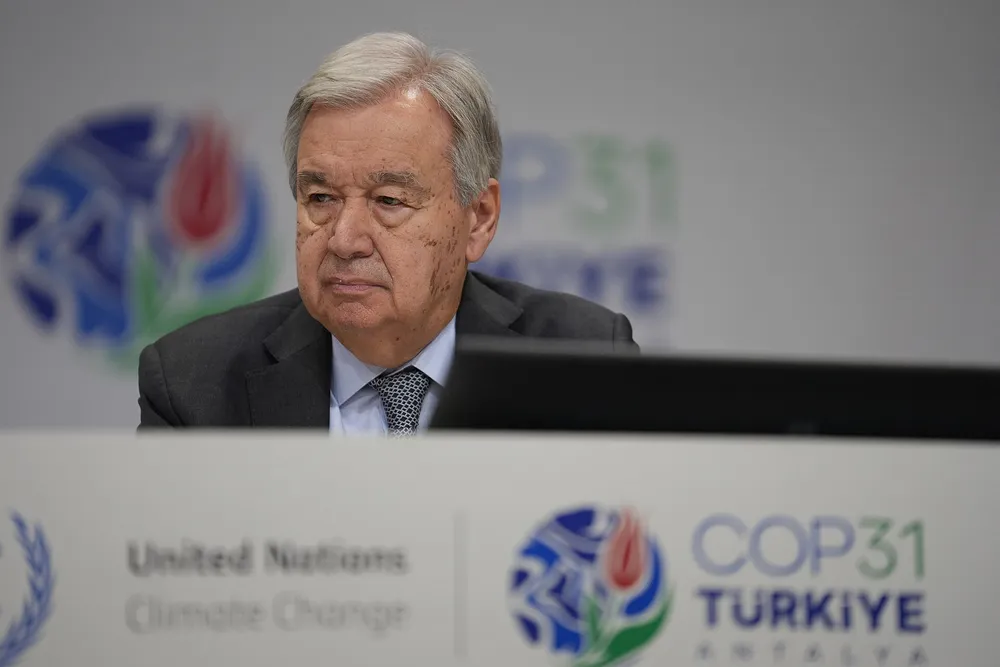
The failed text would have admitted, for the first time, that the world will overshoot the 1.5C limit set in Paris. Current national plans, if every one of them were kept, lead to warming of just over 2.5C. UN Secretary-General António Guterres said he was "deeply disappointed" and that "there is no ambiguity in the science".
Nobody has to guess why the limit is being broken. The same panel found that the fossil fuel plants and pipelines already built will, if they run to the end of their lives, emit more carbon than the 1.5C limit allows. The International Energy Agency concluded in 2021 that a route to net zero leaves no room for new oil and gas fields. Governments are heading the other way and plan to produce 120% more coal, oil and gas in 2030 than that limit can bear. A text that cannot say fossil fuels cannot ask anyone to stop producing them.
Thirty-one summits in, global agreement on the cause of the crisis has gone backwards. In Dubai in 2023 every country signed up to "transitioning away from fossil fuels". Three years later the hosts could not get the two words into a draft.