CNN has stopped promoting the story it used to tell the world that Iran was planning a dirty bomb attack on Washington, and it has not corrected or retracted a word of it. By 23 November the "exclusive" was gone from the network's homepage and its social media accounts had stopped posting it. The article is still online, last updated on 17 November, with no correction, no retraction and no editor's note.
The story ran on 16 November under four bylines and rested on seven unnamed US officials. "New US intelligence indicates that Iran is developing plans to target senior Trump administration officials by detonating a so-called dirty bomb or a chemical weapon in Washington," it began. It named no source and showed no document. Further down, CNN conceded that officials "continue to debate whether Iran can or will" do any of it, that the planning was "an effort to give itself options rather than an indicator of an imminent attack", and that there was no evidence Iran had decided to go ahead. The headline went with the bomb.
Both governments in the story have knocked it down. Iran's mission to the United Nations said Tehran "categorically rejects and unequivocally refutes the false and fabricated allegations", and foreign ministry spokesperson Esmaeil Baghaei said those who started the war "are attempting to manufacture a veneer of legitimacy for further aggression and atrocities". White House spokesperson Lauren Bis said "there are no credible threats to the homeland", and CNN printed that in its third paragraph. Homeland Security Secretary Markwayne Mullin called Iran's planning "aspirational" and no "new threat". Secretary of State Marco Rubio said there was no "imminent threat". The Office of the Director of National Intelligence declined to comment, and no US agency has confirmed the intelligence on the record.
By then the story had gone round the world. CNN ran it as an article and in at least three video segments, and its wire put it on local stations such as WBAL in Baltimore. Within days it was in the Washington Post, Time, Newsweek, Breitbart and on the Reuters wire. It reached Britain through LBC and the Jewish Chronicle, Israel through the Times of Israel and the Jerusalem Post, the Gulf through Gulf News, and newspapers in Bangladesh, the Philippines and Ukraine. All of it traces back to CNN's seven unnamed officials.
The caveats fell away as it travelled. Newsmax's headline was "Iran Plans Dirty Nuke, Chemical Attack on Washington, D.C." National Review wrote about "Iran's D.C. Dirty Bomb Plot" as an established fact. The Hill's headline was "Iran's 'dirty bomb' threat underscores risks to US homeland", and Jewish Insider reported Senate Republicans "unsurprised by Iranian 'dirty bomb' plot". Al Jazeera was one of the few outlets to tell readers that the report "sets out no evidence to support the claims".
The claims CNN let its sources make without challenge go further than the headline. One said "many national security officials assume that pre-positioned nuclear materials have already been in the US for years, if not decades". Another blamed a "porous" border. Nobody was asked for evidence of either.
The same article explains why officials might want such a story in print. A surveillance law that lets the government collect foreigners' communications expired in June. The week before CNN published, Attorney General Todd Blanche, Director of National Intelligence Jay Clayton and CIA Director John Ratcliffe wrote to congressional leaders urging them to renew it because of a "heightened threat environment". CNN reported the lobbying and the anonymous threat side by side and drew no line between them.
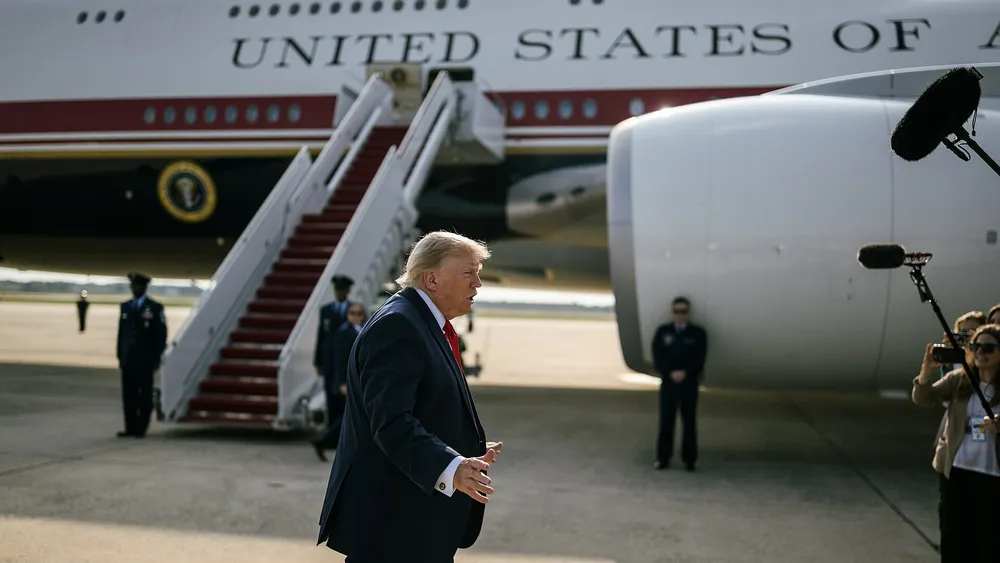
Donald Trump did the rest. In Manila on 17 November he said Iran would "pay a price the likes of which no country has ever paid before" and that "they happen to be crazy". The same day US jets bombed Qeshm Island. On 18 November he told Fox News "If it does happen, we wipe them out," and added a claim of his own, "There's indication that Iran is looking at gases, looking at bio." Mullin said an attack on Washington "would cause an all-out war". By 20 November Trump was calling CNN's exclusive what it is. "There is a rumor that they are building a dirty bomb. If they do, we're going to fight," he said at the White House.
US newsrooms have done this before. In 2003 George W. Bush took the USA to war in Iraq on intelligence about weapons of mass destruction, much of it fed to reporters by unnamed officials and sold to the world in Colin Powell's speech to the UN Security Council. The Iraq Survey Group found no stockpiles, and hundreds of thousands of Iraqis were killed. The New York Times admitted in an editors' note in May 2004 that its coverage "was not as rigorous as it should have been". That note came 14 months into the war. CNN is nine months into this one.
The war began with US and Israeli strikes on Iran on 28 February. Trump bombed Iran again days after his party lost Congress, the US Navy is blockading Iran's ports, and a third US aircraft carrier has arrived in the region. The USA and Israel had already planned more bombing once the midterms were over. A story about an Iranian bomb in Washington is worth a great deal to people who want that.
CNN handed seven anonymous officials a headline about a dirty bomb in the US capital, in the middle of a war their own government started, and a president used it to threaten to "wipe out" a country of 90 million people. The only party still standing behind the story is the network that published it, and it has stopped saying so out loud. Letting a story sink out of sight does not undo it. CNN owes its audience, and Iranians, a retraction and an apology.