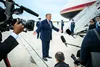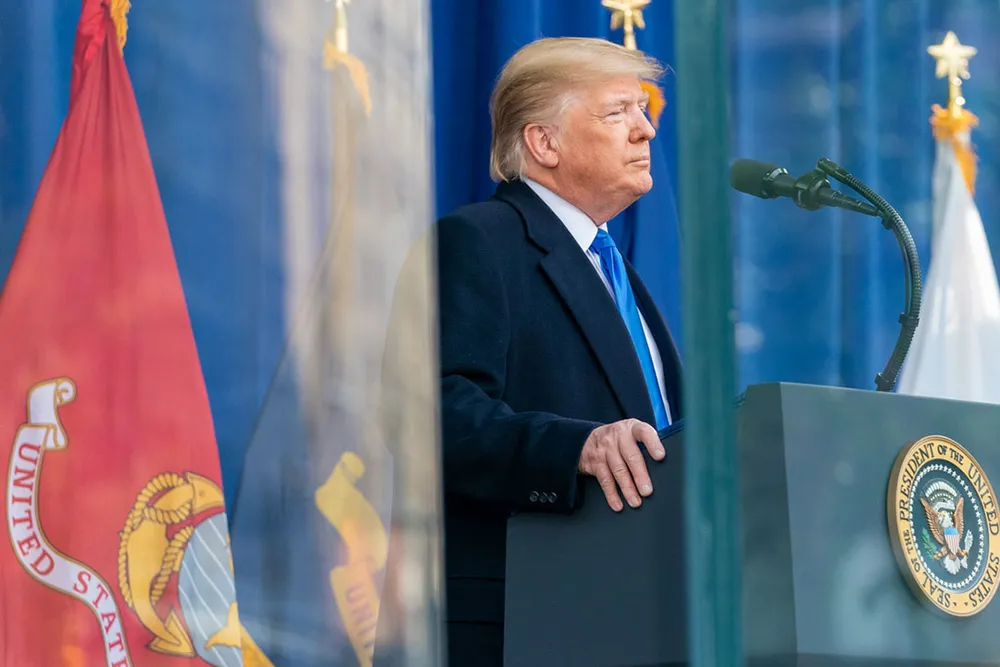
Standing beside Mark Rutte in Ankara on Wednesday, hours before the alliance summit opened, Donald Trump said he had instructed his Treasury Secretary to "Cut off all trade with Spain", adding that visits should stop too and that the country's government were hopeless people not worth speaking to. Reuters and other outlets claimed it was an order.
The sentence is an order in grammar only. Spain does not have a trade policy for the U.S. regime to sever. Under Article 207 of the Treaty on the Functioning of the European Union, the common commercial policy is an exclusive competence of the Union, which means Madrid cannot set a tariff, sign a trade agreement, or accept a trade sanction on its own behalf. There is no bilateral channel between Washington and Madrid to close. When the regime negotiated its tariff framework with Europe last year, it negotiated with the Commission, because there was nobody else to negotiate with.
Customs officers do record country of origin, so an origin-based measure against Spanish goods is draftable on paper. What it is not is bilateral. A tariff on Spanish olive oil or Spanish steel is a tariff on a member state of a customs union that has, since 2023, held a standing instrument for exactly this scenario.
The anti-coercion regulation exists to convert an attack on one member into a response from twenty-seven. Any blow aimed at Sánchez arrives addressed to Brussels, and the retaliation returns from Brussels, calibrated across the bloc's leverage in services, digital, and procurement. Spanish goods that undergo substantial transformation in another member state also stop being Spanish for customs purposes, which is the kind of detail that turns an embargo into a paperwork exercise for shipping agents.
The domestic obstacle is larger. On 20 February the Supreme Court struck down the regime's tariffs, holding six to three that the International Emergency Economic Powers Act does not give a president the power to impose them, that the word "regulate" has never been read to include taxation, and that a power of this economic magnitude requires Congress to grant it explicitly.
The regime terminated the tariffs four days later and reached for Section 122 of the Trade Act of 1974, a temporary global surcharge capped at fifteen percent and expiring after a hundred and fifty days. Section 122 is a balance-of-payments authority, and the USA ran a surplus with Spain of just under four billion dollars in 2025 on total trade of $74.5 billion. There is no deficit to invoke.
That leaves one route, and it explains why Bessent was the name in the sentence. Treasury does not administer tariffs, Commerce and the trade representative do. Treasury administers sanctions. A total prohibition on trade with Spain would be a sanctions programme built on a declared national emergency over an unusual and extraordinary threat originating abroad, the legal architecture used against Iran and Cuba, pointed at a NATO member that raised defence spending from 1.4 to 2.1 percent of GDP in four years. It would be enjoined within the week and it would be the first time a president attempted to sanction an ally for declining to buy more weapons.
Spain refused the five percent target and secured a carve-out, and in March, after Moncloa blocked the use of the Rota and Morón bases for the bombing of Iran, the regime began threatening economic reprisals. What is being punished is a sovereign refusal to host a war. Rutte, sitting beside him, cut in to point out that Spain had in fact moved, which is roughly the posture the alliance now maintains, correcting the president gently while agreeing with him in principle.
The Spanish government treated the remarks as routine and noted that the relationship benefits both parties. The ten-year yield rose seven basis points and the IBEX fell. That gap, between an instruction with no instrument behind it and a bond market that priced it anyway, is what the announcement was for.
It costs the regime nothing to say, it cannot be executed, and it still extracts a small tax from Spanish borrowers and a large one from the coverage, which spent Wednesday explaining what Bessent might do rather than why he cannot do it. An order that cannot be carried out is not a failure of policy if the audience never checks. It is a policy in itself, and the discipline it enforces is not on Madrid, it is on everyone watching Madrid, calculating what refusing the next request will cost.