CENTCOM released videos of the strikes
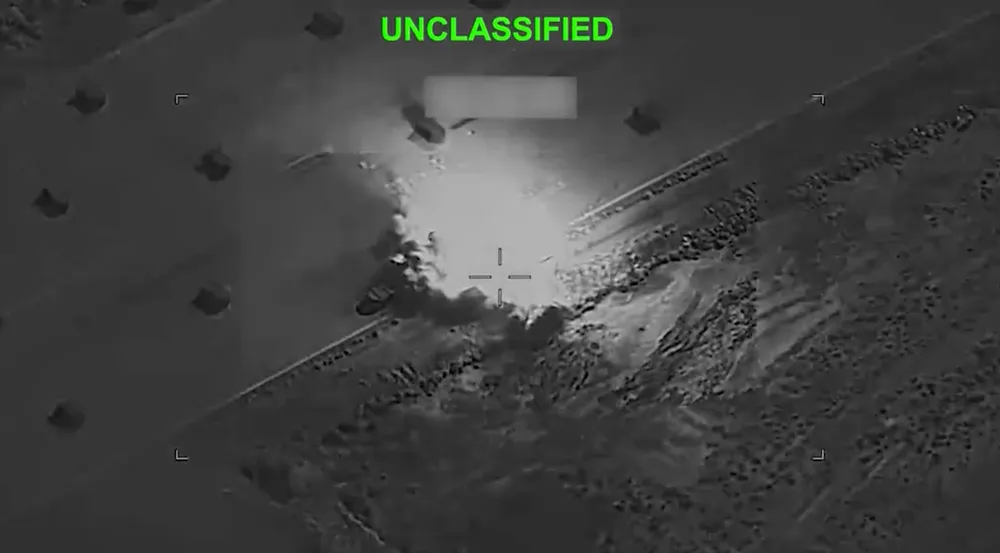
U.S. forces bombed Iran for a second consecutive night on Wednesday, hitting roughly ninety targets in strikes that ran until daybreak on Thursday, U.S. Central Command said. The attacks reached ports, islands, an airport and at least one railway bridge, killing a firefighter and, according to Iranian state media, at least three people in Khuzestan province. Tehran says fourteen people have been killed and seventy-eight wounded across the two nights.
Central Command said its forces struck air defence systems, coastal surveillance assets, missile and drone storage sites, naval capabilities and military logistics infrastructure along Iran's coastline. The stated purpose, repeated in the statement and by every U.S. official briefing reporters, is to degrade Iran's ability to threaten shipping in the Strait of Hormuz, the channel at the mouth of the Persian Gulf carrying about a fifth of the world's oil. Iranian air defences were activated across the south. Warplanes were heard over Kish, Iran's largest island near the strait.
Locations along the strait where strikes or explosions were reported:
- Bandar Abbas, eight explosions per state television
- Sirik, two projectiles at the commercial pier
- Jask, two explosions, with three more near the village of Tahrouyi
- Qeshm Island
- Kish Island
- Abu Musa Island
- Kuhestak
The worst civilian damage was at Chabahar, a port on the Gulf of Oman near the Pakistani border and several hundred miles east of the strait. IRNA reported around ten explosions.
Power went out across half the city. State broadcaster IRIB said two piers were hit and that debris from the strikes struck the Imam Ali hospital. The head of the Chabahar Free Zone Organization, Mohammad Saeed Arbabi, confirmed the free zone tower was targeted and damaged, and CNN geolocated video showing the damage.
Locations beyond the strait where strikes or explosions were reported:
- Chabahar, including two piers, the free zone tower and hospital damage from debris
- Konarak
- Bushehr, where a provincial official said two military bases were hit at Dashti County and Choghadak; Iranian media said the nuclear power plant was undamaged
- Kharg Island, the terminal handling most Iranian crude exports
- Iranshahr Airport, where a firefighter was killed
- Khuzestan province, at least three killed on Thursday
- Aqqala, Golestan province, where cruise missiles struck around a railway bridge
Golestan is the detail that does not fit. The province lies in Iran's far northeast, on the Caspian side of the country, roughly nine hundred miles from the strait CENTCOM says these strikes are meant to keep open. The IRGC unit stationed there said U.S. cruise missiles hit around the Aqqala bridge. The Guard separately said two bridges had been attacked on the road to Mashhad, where Ali Khamenei, the supreme leader killed in the opening hours of the war in February, was to be buried on Thursday. Trains from Tehran to Mashhad were suspended. These are the first reported strikes on Iranian bridges since April. Iran's foreign ministry called the bridge attacks a gross war crime.
Speaking in Ankara on Wednesday, Trump had already told reporters what was coming and why. He said the memorandum of understanding that paused the war was over, that he considered further negotiation a waste of time, and that Iranian leaders were "scum." He announced the strikes in advance: "I'll give them a little warning, we're going to hit them hard again tonight."
He said the USA might "just finish the job," and raised the possibility of striking Iranian power stations and desalination plants, adding that he did not want to but would take them out if he had to. He suggested the USA could denuclearise Iran without a deal. Later, on Truth Social, he posted a photograph of Chabahar burning, taken from another account, and warned it would get much worse.
Desalination plants supply drinking water to Iran's coastal cities. Deliberate attacks on objects indispensable to civilian survival are prohibited under the Geneva Conventions. The threat was reported across the U.S. press as a bargaining position.
On Tuesday three commercial vessels were struck in the strait, along unapproved routes and accompanied by U.S. naval ships. Iran did not claim responsibility, though its state broadcaster said one ship had ignored warnings. The USA responded with strikes on more than eighty targets, including over sixty Revolutionary Guard small boats by CENTCOM's own count; Trump later put the figure at twenty-eight. On the same day, the U.S. Treasury revoked the licence permitting Iran to sell oil, issued less than three weeks earlier as part of the agreement and meant to run toAugust. Iran's chief negotiator called that a major violation of the deal. A U.S. official told CNN the strikes were not proportional and described them as punishment.
The Iranian regime then fired on Bahrain and Kuwait, host to the U.S. Fifth Fleet and to U.S. Army forces. The Revolutionary Guard claimed eighty-five American military sites hit. Kuwait's military said it detected two ballistic missiles and thirteen drones and intercepted all of them. Those accounts are irreconcilable and neither has been independently verified. After Thursday's wave, Iran struck again and wider, taking in Qatar alongside Bahrain and Kuwait. Sirens sounded at least twice in Bahrain. Kuwait's air defences engaged incoming missiles and drones.
Iran's ambassador to the United Nations, Amir Saeid Iravani, wrote to the Security Council calling the U.S. attacks a clear violation of the UN Charter. Iran's parliament speaker said that if the USA strikes, it will be hit. António Guterres called for maximum restraint. Egypt, Qatar, Jordan and Kuwait condemned Iran's attacks on the Gulf states. NATO Secretary General Mark Rutte, seated beside Trump, called the U.S. strikes absolutely necessary. Oil rose eight per cent. Flying home, Trump told reporters Iran had "called a little while ago, they want to make a deal so badly," an assertion no government has confirmed.
The memorandum of understanding has a central bargain, an end to hostilities in exchange for open shipping, it has been abandoned on both sides inside three weeks: by Tehran when it began attacking vessels that used routes it had not approved, and by Washington when it dragged ships into those routes, cancelled the oil licence and resumed bombing at a scale it now says was never meant to be proportionate.
Ninety targets in a night, on four separate coasts, a thousand miles apart, is the tempo of a war rather than a reprisal. The President of the United States has said the deal is finished, that talks are pointless, that the job might as well be completed, and that the water and power supplies of Iranian cities are on the table. Iran fired on civilian ships and that is a crime against the crews aboard them. The USA's answer arrived at a hospital in Chabahar, at an airport in Iranshahr, and at the bridges on the road to a funeral, and it was announced from a podium in Ankara hours before it landed, to a room of reporters who wrote it down and waited.