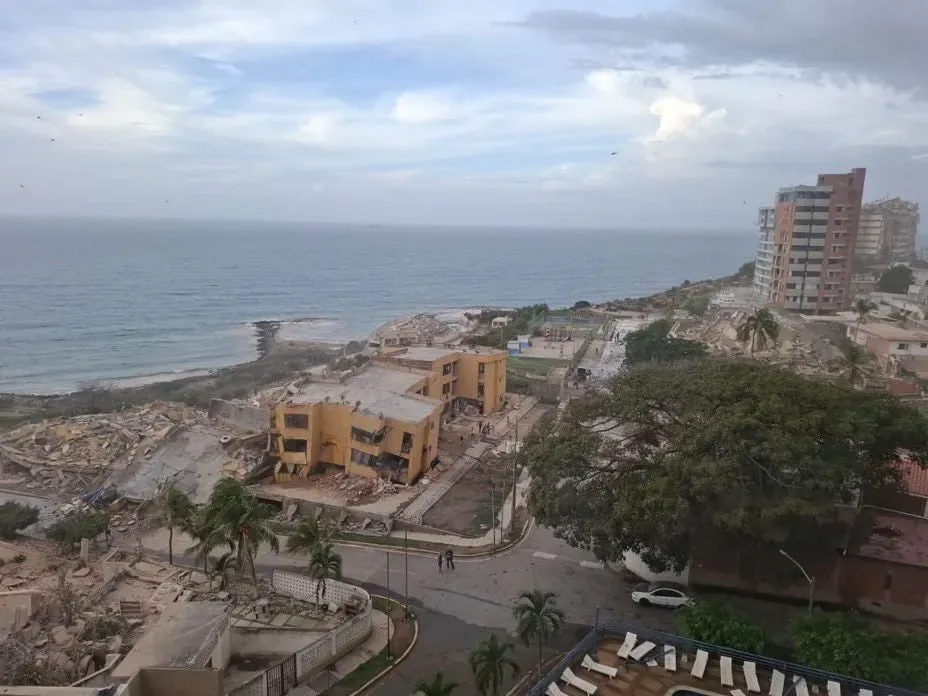
Two earthquakes struck northern Venezuela on Wednesday evening within seconds of each other. The first, a magnitude 7.2, hit at around 6 p.m. local time, and a stronger magnitude 7.5 followed around 40 seconds later in the same area.
Their epicentres were near the towns of San Felipe and Yumare, roughly 100 miles west of the capital, Caracas. The U.S. Geological Survey, the American agency that monitors earthquakes worldwide, recorded the 7.5 as the largest to hit Venezuela since 1900, when a magnitude 7.7 struck the country. Buildings collapsed across Caracas, and the tremors were felt as far away as Brazil's Amazon, more than 1,000 miles to the south.
The official toll stands at 188 dead and at least 15,000 injured, according to Venezuela's acting president, DelcyRodríguez, and that figure does not yet include the coastal state of La Guaira, the area believed to be worst hit. United States government scientists have warned the eventual death toll could run into the tens of thousands, and the disaster has been placed under the agency's highest alert level.
No government figure exists for the number of missing. Communications have collapsed across the affected areas, leaving families unable to phone or message relatives, and many spent Thursday walking through rubble searching by hand.
In the absence of any official register, Venezuelans abroad built their own. Two websites, Desaparecidos Terremoto Venezuela and Venezuela Te Busca, now let people log the names of relatives they cannot reach and mark others as safe once they are found. More than 10,600 people have been logged as out of contact, though that number reflects who cannot be reached as much as who is genuinely lost.
Rodríguez, who released the latest official toll early on Thursday, called La Guaira a "true tragedy" and a "disaster zone." Rescue teams are being pulled from other parts of the country and sent there, which means the official count of 188 is near certain to rise once that state is included.
Parts of Caracas lost power and cellphone coverage, and the quakes damaged and closed Simón Bolívar International Airport, the country's main hub. One runway is cracked, complicating the arrival of aid aircraft.
Subway services were suspended in the capital and natural gas shut off, classes were cancelled for several days, and some school buildings are being used as shelters and donation centres.
At least 30 aftershocks have been recorded since the two main quakes, and the U.S. Geological Survey forecasts a 40 percent chance of another magnitude 6 or larger in the same region within a week. Rodríguez declared a state of emergency and announced a $200 million fund to rebuild damaged hospitals and homes.
Help has been offered from abroad. Ecuador ordered humanitarian aid delivered, and Qatar, Mexico and El Salvador have already sent rescue personnel. China, Argentina and Brazil pledged support, Iran's Red Crescent has offered to send rescue teams and Canadian Prime Minister Mark Carney called the quakes "catastrophic" and said Canada is preparing assistance. Rodríguez said she is coordinating with the United Nations to send rescuers.
The United States, whose military captured the country's former leader Nicolás Maduro in January and brought him to the U.S. to stand trial, is now deploying search and rescue teams, medical resources and humanitarian aid, with Secretary of State Marco Rubio promising a response that would be "big," "fast" and "effective."
Rubio said teams from Fairfax County, Virginia, and Los Angeles may already be on their way, that the Department of War would move assets to the damaged airport, and that the U.S. is supplying overhead imagery of coastal areas where Venezuelan authorities cannot yet see the full extent of the damage.