Two years in, the numbers do the thing the bombing never could. They make the scale legible.
We have spent twenty-six months watching this told one strike at a time, one collapsed building, one named child, one funeral filmed on a phone. That is how genocide is metabolised in real time, in fragments small enough to scroll past. The accounting is different. The accounting refuses the fragment. It lays the whole thing out on a single page and asks you to read it as one fact, which it is.
Euro-Med Human Rights Monitor laid that page out in October, under a title that is not a slogan but a finding: no one fully survived. More than 270,000 people in Gaza, roughly twelve per cent of the population, have been killed, injured, detained, or disappeared since October 2023. Not a generation touched by war. A generation inside it, all of it, with no exterior left to flee to.
Here is what we can say with sourcing, and here is what has changed since October, because some of it has changed and not in the direction anyone promised.
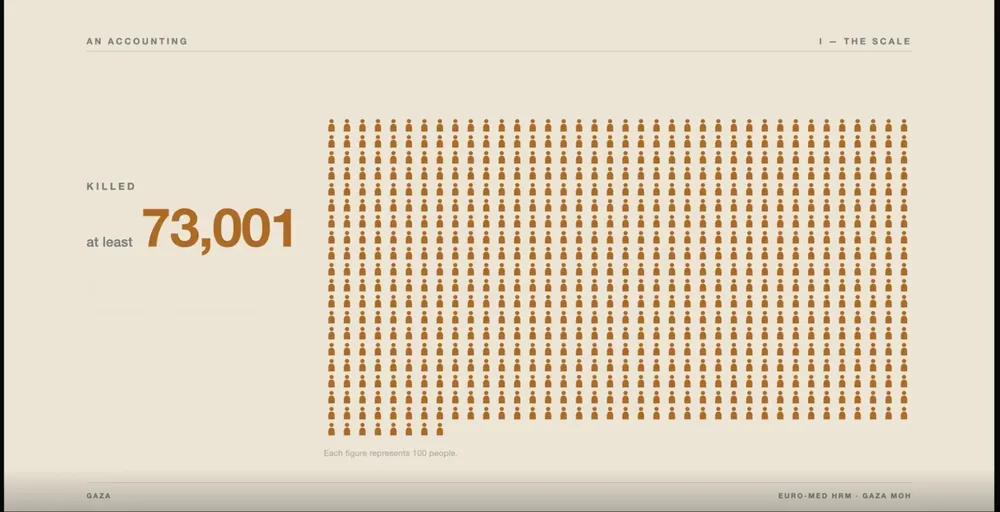
The Gaza Ministry of Health put the registered death toll past 73,000 in June, a figure the United Nations and independent researchers treat as broadly reliable and almost certainly an undercount, given the thousands still under rubble that nobody has the equipment to lift. Euro-Med's own estimate, which includes the presumed dead beneath the concrete, ran higher still.
The number that should arrest you is the smaller one. The ceasefire took effect in October. By mid-June, the Health Ministry counted 1,008 Palestinians killed since it began. A truce was announced, the bombing was said to have stopped, and more than a thousand people died anyway, in their tents, on the roads, in what remained of their homes. The UN human rights chief, marking six months of the agreement, said Palestinians have no blueprint for survival, that wherever they go and whatever they do there is no safety afforded to them. The ceasefire reduced the rate. It did not end the dying. That distinction is the whole story of the last eight months.
Of the dead Euro-Med had counted by October: 70,248 civilians, 21,310 children, 13,987 women. Nine in every ten people killed were civilians. The war left 45,600 orphans behind, a number that is itself a kind of forecast, a measure of the adults who will not be there.
173,200 people have been wounded, a figure that has barely moved in the official reporting not because the injuring stopped but because the system that records it has largely collapsed. Forty thousand will live with permanent disability, twenty-one thousand of them children. More than ten thousand children have lost at least one leg. Gaza now holds the largest population of child amputees in modern history, which is the sort of record no place competes for and every place should fear.
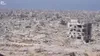
The Israeli regime did not only kill people, it dismantled the conditions that make a people. 555,000 housing units, 621 schools, 890 mosques, 191 press headquarters, 205 heritage sites, all destroyed or damaged. Every hospital in the strip, all of them, hit. Ninety-five per cent of schools and universities. Eighty per cent of every building standing. Israeli forces still hold more than sixty per cent of Gaza's territory, where residents are ordered out and what is left is flattened, so these are not final figures, they are floors. Israeli leadership has already instructed the IDF to expand their area of control to 70% of Gaza.
Among the dead were the people who keep a society legible to itself. 1,701 healthcare workers. 800 teachers. 200 academics. And the press: the Committee to Protect Journalists now counts more than 260 journalists and media workers killed since October 2023, the deadliest war for journalists it has recorded since it began counting in 1992. The killing of reporters continued through the ceasefire, which tells you what the ceasefire was for.
Some of the killing does not register as killing, which is precisely its design. Twelve thousand Palestinians were detained or forcibly disappeared, 2,700 still held. From a hundred released detainees Euro-Med documented forty-two distinct forms of torture, a number that reads less like an indictment than an inventory.
Then there is hunger, which the International Court of Justice was asked to stop in January 2024 and which the regime answered by accelerating. By October, 482 people had died of malnutrition, 160 of them children. The Integrated Food Security Phase Classification, the global authority on famine, projected that through June 2026 at least 132,000 children under five would be acutely malnourished, more than 41,000 of them severely, at heightened risk of death. As of December, more than three-quarters of the population, around 800,000 of them children, were still facing acute food insecurity. Aid was allowed in. It arrived inconsistently, and far below what the ceasefire required, and starvation is not a thing you negotiate down by half.
People ask what numbers are for, when each one was a person and the arithmetic flattens that. The answer is that the flattening is the regime's preferred outcome, not ours. A figure that nobody compiles is a death that nobody records is a crime that nobody prosecutes. The count is the resistance to forgetting, it is the paper trail laid down in advance of a court that may one day read it, it is the refusal to let two years dissolve back into a thousand unconnected tragedies.
Two years. Seventy-three thousand dead and rising. A ceasefire that kept the morgues open. The world watched all of it in high resolution, in real time, with the receipts, and decided that watching was a sufficient response. We are still counting, because someone has to, and because the alternative is the version of events the people who did this would very much prefer.
Two years, by the numbers
(Euro-Med, as of 18 October 2025)
- 270,000+ killed, injured, missing or detained, around 12% of the population
- 73,001 killed (official Ministry of Health count, June 2026)
- 1,008 killed since the ceasefire began in October 2025 (as of 18 June 2026)
- 173,200 injured
- 99% forcibly displaced at least once
- 9 in 10 of the dead are civilians
Who they were
- 70,248 civilians
- 21,310 children
- 13,987 women
- 30% of casualties children, 20% women
- 45,600 orphans
- 10,000+ children have lost at least one leg
What was destroyed or damaged
- 555,000 housing units
- 3,300 industrial facilities
- 621 schools
- 890 mosques
- 205 heritage sites
- 191 press headquarters
- 3 churches
- 100% of hospitals
- 95% of schools and universities
- 80% of all buildings
Personnel killed
- 263 journalists and media workers
- 1,701 healthcare professionals
- 194 doctors, 376 nurses
- 2,195 healthcare professionals injured
- 140 civil defense workers
- 800 teachers
- 200 academics and professors
Conditions and indicators
- 40,000 living with permanent or long-term disability, including 21,000 children
- 24% lower-limb, 76% upper-limb amputations
- 12,000 detained or forcibly disappeared, 2,700 still held
- 42 documented forms of torture, from 100 detainee interviews
- 482 malnutrition deaths, including 160 children
- 300% increase in miscarriage rates
- 77% of the population facing acute food insecurity
- 80% of aid missions to northern Gaza obstructed
- 100% have suffered psychological trauma
- 98% drop in per-capita water share
Figures: Euro-Med Human Rights Monitor and the Gaza Ministry of Health, with journalist deaths from the Committee to Protect Journalists and food-security data from the IPC. Casualty-component and infrastructure figures reflect Euro-Med's tally as of 21 October 2025; death-toll, post-ceasefire, and press figures are current to June 2026.