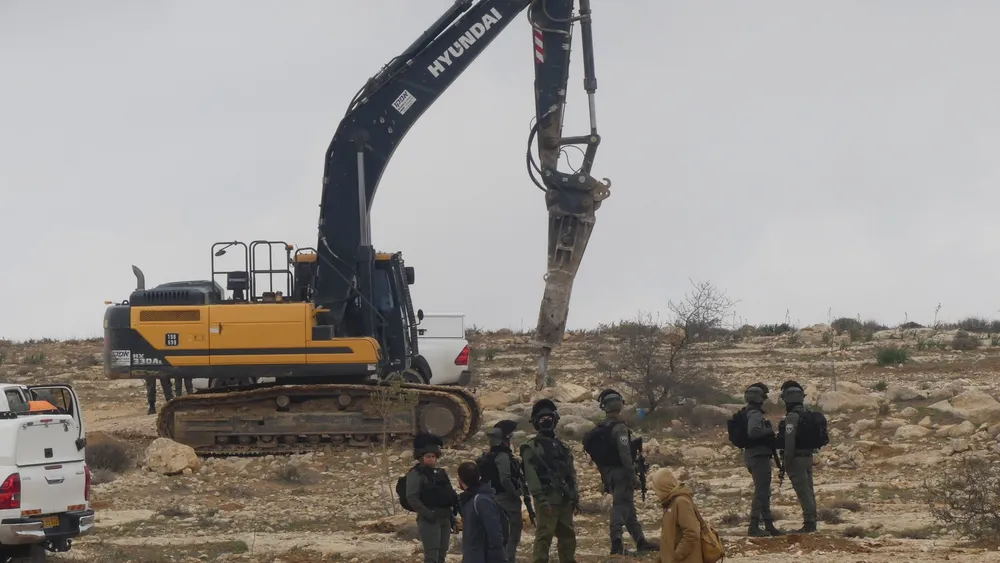
Israeli soldiers have forced about 2,200 Palestinians out of their homes in Hebron since Friday night, the city's mayor, Youssef al-Jaabari, says, and have flattened every house across several blocks and marked others with black crosses. Hebron's municipality says 35 hectares of the Ein Deir Baha district have been destroyed or marked for destruction, and the mayor says the army plans to drive out 2,500 people in all.
Soldiers entered Ein Deir Baha, al-Jalda, Wadi al-Maghariba and Shi'b al-Milh around midnight and ordered people out over loudspeakers.
Abdul Hamid Shahada told Middle East Eye that soldiers gave the 54 people in his building, most of them children, and his ailing 79-year-old mother five minutes to leave, marched them out with their hands behind their heads and banned them from taking anything but small bags.
A 90-year-old woman had to be carried out because she is ill. Families were told they could go home "until further notice", and some spent the night outdoors. The municipality has opened the Childhood Happiness Centre, the Korean Centre and family guesthouses to shelter the rest.
Israel is doing this because two Palestinian resistance fighters, Ahmad and Hamouda al-Joba, attacked the soldiers at the Farsh al-Hawa checkpoint outside Hebron on Friday and killed two of them, before troops killed both men.
Benjamin Netanyahu said Israel would "act to destroy this place" and locked down the whole West Bank. His defence minister, Israel Katz, wrote that "the Jenin refugee camp model arrives in Hebron", the model that has driven at least 33,000 Palestinians from their homes in the northern West Bank. Bezalel Smotrich filmed himself in body armour in front of a Palestinian building being demolished, said he had ordered "the immediate demolition of a wide row of illegal Arab structures" and called for a campaign "exactly like in Gaza and Lebanon".
Khaled Shawer al-Tamimi, 68, who was ordered out with his family, told AFP he had never heard a gunshot fired in the neighbourhood. "Why should I be displaced from my house?" he asked.
Issa Amro, whose sister Hayat and her seven children were among those forced out, said: "We are being collectively punished for something we neither did nor supported. Our suffering is being turned into political material for Israel's elections, while innocent families pay the price." Israel votes next week, and Netanyahu is level in the polls with Gadi Eisenkot's opposition bloc.
Collective punishment is banned by Article 33 of the Fourth Geneva Convention, and the forcible transfer of an occupied population is a war crime under the Rome Statute. The UN human rights office called the lockdown part of "a pattern of collective punishment" that follows every Palestinian attack. B'Tselem described the operation as part of Israel's ethnic cleansing and called on governments to act "to prevent the forcible displacement of Palestinian civilians, collective punishment and extensive unlawful destruction in Hebron".
All 250,000 people in Hebron are sealed in behind checkpoints at every entrance to the city. Soldiers have arrested at least 13 people and held dozens more for interrogation in the street, and the army says the operation will last several days. Netanyahu told i24News there is "a very big surprise for the Palestinian Authority as well". Soldiers have told some of the families they will be kept out of their homes for six months to a year.