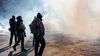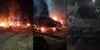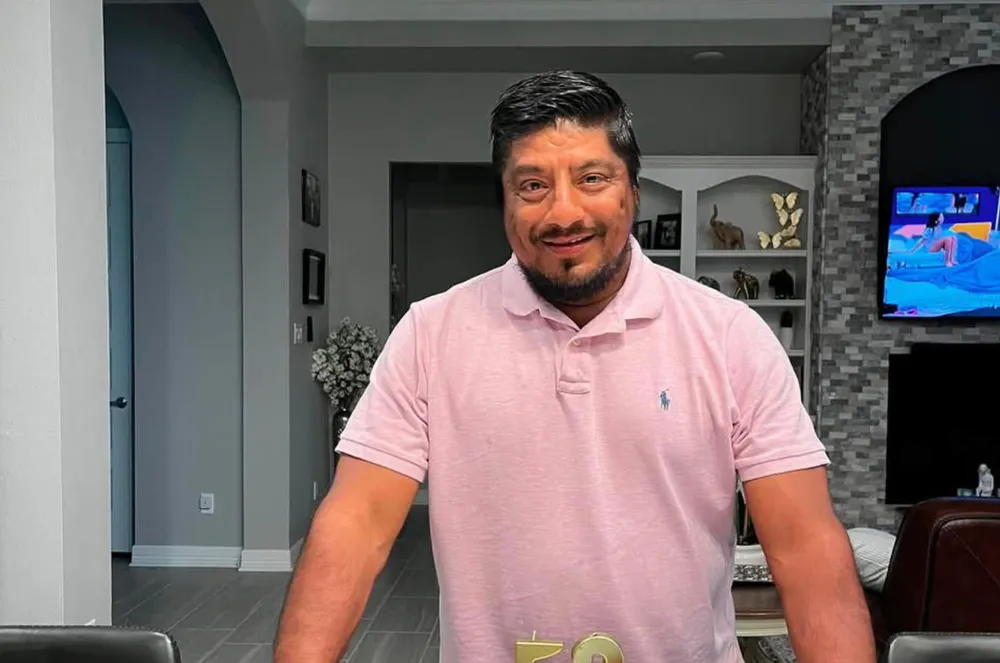
Lorenzo Salgado Araujo was 52 years old, had lived in the USA for about 35 years, and built houses in Houston. On Tuesday morning, a little before 7 a.m., he was driving a white van through Magnolia Park on the city's east side, picking up the last of his crew before a job in the north of the city. His brother was with him, along with two of his workers. Officers of Immigration and Customs Enforcement, the federal agency conducting the Trump regime's mass deportation programme, stopped the van on Canal Street. One of them shot him once in the right side of his abdomen. He died at Ben Taub Hospital. On Thursday the Harris County Medical Examiner ruled the death a homicide.

With over 1,700 agents identified and over 5,000 under review, our ICE list is the largest publicly available database of ICE Agents.
We will hold this list as long as the USA is under the thumb of fascism, regardless of the many threats made towards us.
Within hours of the shooting, before any investigator had spoken to any witness, the Department of Homeland Security told the public what had happened. Salgado Araujo had tried to escape, rammed an ICE vehicle, ignored repeated commands, and "weaponized his vehicle in an attempt to run over an ICE law enforcement officer", who fired in self-defence. That account went out on the wire services and led the broadcasts. It is still, three days later, unsupported by a single piece of evidence the department has been willing to show anyone.
It is also, piece by piece, coming apart, and it is coming apart in a way that will be familiar to anyone who followed what happened in Minneapolis this past January.
Salgado Araujo was not the target of the stop. ICE's acting director, David Venturella, told the local congresswoman, Sylvia Garcia, by phone on Thursday that the man the agency was hunting was somebody else.
Garcia's office says the warrant was for one of the other men in the van: "Another passenger had an administrative warrant and was the target." The New York Times, citing DHS, reports the warrants were for two Guatemalan men who were not in the van at all. The family says the four men in that van were Mexican. Both stories cannot be true, and neither is the account the department gave the public on Tuesday, immediately throwing doubt onto the official account.
Were you there? Tell us.
There is no body-camera footage of this killing and no dash-camera footage. What happened on Canal Street exists only in the memories of the people who were there and on the cameras above their doors. If you were near the 6800 block of Canal Street between about 6:15 and 7:30 a.m. on Tuesday 7 July, we would like to hear from you. We would also like to hear from anyone detained in the operation, from relatives and lawyers of the three men held in Conroe, and from current or former ICE and DHS staff who know how this operation was authorised and briefed.
If you have footage: do not crop, trim, filter or re-encode it, because the hidden data in the original file is often what makes it usable as evidence. Many doorbell and shop systems delete recordings within days, so export the original now and keep copies in two places. You are not obliged to hand original files or devices to federal agents without a warrant or a subpoena, and you should speak to a lawyer before you do.
Sending us something does not stop you sending it to anyone else. The Harris County District Attorney is asking witnesses to come forward. LULAC is offering a $5,000 reward for information and footage. Send it to all of us.
An administrative warrant, for readers who have had no reason to learn the distinction, is not a warrant in the sense most people mean. No judge reviews or signs it. It is a form an immigration agency fills out about itself. Armed with one of those, and a tip from an unnamed police force, ICE officers spent weeks watching a house where they had noticed two white vans. On Tuesday they saw a white van with a man in it who they thought resembled the man they wanted. They stopped it. The van belonged to Lorenzo Salgado Araujo, who is now dead because he owned a common vehicle and had a common face.
Venturella confirmed to Garcia that the officers wore no body cameras and their vehicles had no dash cameras. The department has since said that its officers had not been issued the equipment, and has blamed the delay on Democratic-led government shutdowns. Whatever the reason, the effect is fixed. The agency that shot a man has produced no recording of shooting him, and the only recordings that exist were made by people who happened to be nearby.
Three men were in that van and all three saw the shooting. All three are in ICE custody, at the Montgomery ICE Processing Center in Conroe. Through their attorney, Hugo Balderas-Ibarra, they have told the Washington Post that the department's account is false: that the van never rammed anything, that the ICE vehicles struck the van rather than the reverse, that Salgado Araujo never steered toward the officer, and that the officer fired almost as soon as he was out of his own car. "At no point were these ICE agents' lives ever in any danger," Balderas-Ibarra said. The chief executive of LULAC, Juan Proaño, says immigration officials are now pressing those three men to agree to self-deport. If they do, the only independent eyewitnesses to the killing will be in Mexico.
Then the wound. Salgado Araujo was shot in the right side of the abdomen, from the passenger side of his own van, by an officer who says he fired because he was about to be run down. A former Secret Service agent who reviewed the available footage for KPRC said he could not tell from it who made contact first, could not date the damage to the van, and could not say whether the force used was lawful, but that the position of the wound will require an explanation. Surveillance video from the businesses on that corner shows the van moving slowly, two dark vehicles closing on it, one cutting across the front, the van turning and slowing toward the kerb. It does not show the shot. What was filmed afterwards, by a neighbour called Juliet Martinez, shows a handcuffed man face down on the road, bleeding, groaning, one leg shaking, while officers stand over three other handcuffed men.
None of this is new. On 7 January in Minneapolis, an ICE officer named Jonathan Ross shot Renée Good, a 37-year-old U.S. citizen and mother of three, through the windshield of her car. DHS put out a statement within two hours calling her a violent rioter who had weaponized her vehicle in an act of domestic terrorism. The president said she had run the officer over violently, wilfully and viciously. Then the videos arrived. Analysis of verified footage by ABC News showed her turning the wheel away from the officer roughly a second before the first of three shots. Her car sat unexamined in an FBI warehouse for months while state investigators were kept away from it.
Eight days later, in the same city, federal agents shot Julio Cesar Sosa-Celis, who survived. DHS said he had violently assaulted an officer with a snow shovel or a broomstick, and the Justice Department charged him with assault. Video that surfaced afterwards showed him dropping the object before the struggle began, and showed a struggle that lasted about twelve seconds rather than the three minutes the agent described. The Justice Department dropped the charges. DHS eventually acknowledged that two of its officers appeared to have made untruthful statements and placed them on leave.
Nine days after that, Border Patrol agents killed Alex Pretti, a 37-year-old intensive care nurse and U.S. citizen with a permit to carry a handgun. The homeland security secretary said he had come at officers with a semiautomatic and violently resisted. The president's deputy chief of staff said he had tried to assassinate federal law enforcement. Bystander video from at least four angles showed him holding a phone, showed an agent removing the gun from his waistband while he was pinned to the ground, and showed two agents firing around ten times in under five seconds, some of it after he stopped moving. Days later the White House explained that its initial account had come from the agents on the ground. The deputy attorney general conceded that what Pretti did bore no resemblance to terrorism.
And in March 2025, on South Padre Island in Texas, a Homeland Security Investigations agent shot dead Ruben Ray Martinez, a 23-year-old U.S. citizen, at a roadblock. The federal involvement in his death was kept from the public for nearly a year. When it emerged, DHS said Martinez had weaponized his vehicle.
That phrase is not a description. It is a template, filled in before anyone at the department could possibly know what happened, and deployed with such regularity that Newsweek counted at least a dozen incidents in which DHS has claimed a vehicle was used as a weapon against its officers. Its function is to occupy the first news cycle, when the public is paying attention and the footage has not yet surfaced. By the time the footage surfaces, the story has moved on, the agency has not corrected itself, and no officer has been charged in any of the deaths.
The investigation into Tuesday morning is being run by the Office of Inspector General at the Department of Homeland Security, which is to say by the department. The FBI's Houston office is investigating the alleged assault on the officer, which is to say it is investigating the dead man. The Harris County District Attorney has opened the review his office opens whenever anyone dies in an encounter with police, and says he is not being given the evidence. The mayor of Houston says the city has no jurisdiction. The Texas Rangers are standing back. Mexico, which has now announced it will seek criminal charges over the deaths of seventeen of its nationals in U.S. immigration custody or during enforcement operations, has more institutional appetite for finding out what happened on Canal Street than any authority in Texas.
Salgado Araujo's family is still asking for his body.
What remains is what remained in Minneapolis and Texas: a version of events issued by the agency that killed someone, unsupported and uncorrected, while the agency protects the killer from any repercussions.
Every time an ICE killing is caught on camera, ICE are in the wrong. Every time, they provide justification that falls apart under the lightest scrutiny. This is why we needed to make our ICE List, the USA is under the thumb of fascism, things only get worse from here, not better.