When Donald Trump returned to office in January 2025, U.S. Immigration and Customs Enforcement held about 40,000 people in detention on any given day. By this January it held more than 73,400 at once, the most in the agency's history. That one figure is the clearest way into a story the government otherwise tells in fragments: in eighteen months the administration has turned immigration enforcement into the central project of the federal state, and it has done so faster than almost anyone expected.
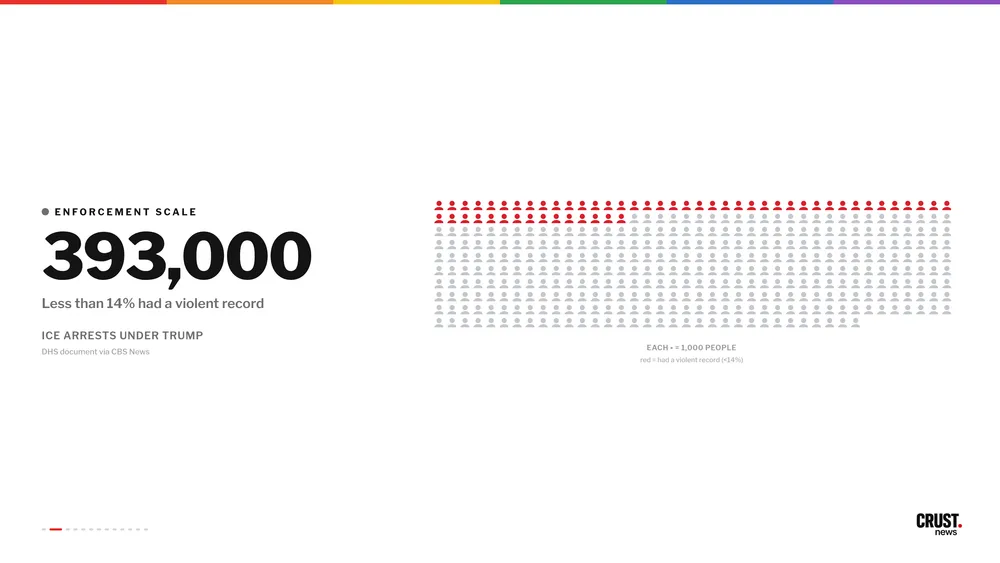
In Trump's second term, ICE arrested roughly 393,000 people for immigration violations. The regime justified that number, and still does, by describing the people it detains as dangerous criminals. Its own data does not bear this out.
Fewer than fourteen percent of those arrested had any record of a violent offence, and the share of people in detention with no criminal conviction at all has now climbed past seventy percent. Stated plainly, most of the people the United States is currently detaining have been convicted of no crime.
Then there is deportation, and here a problem most coverage skips past. The administration promised to deport a million people a year.
Measuring whether it has come close is harder than it should be, because the government does not publish a single trustworthy number. Two separate agencies, ICE and Customs and Border Protection, each keep their own removal records; the two overlap; and neither will say by how much, so the independent analysts who track this refuse to combine them into one number.
The most defensible figure, ICE's own removal count, stands at about 290,603 since the term began. That is only around seven percent higher than Biden's last full year in office, and it was reached after tens of billions of dollars and the largest redeployment of federal personnel to immigration enforcement the country has ever seen. The machine is vast, but its actual output is not, its actual output is a lot smaller than even the Trump regime would want you to believe, despite staggering increases in the number of people taken.
What has changed, then, is two fold. First, is the fact that many remain in ICE concentration camps, being held for reasons we don't know, and can't explain, despite having a wealth of data. The second, is that it's not how many people are removed but who is being swept up to begin with, because ICE has broadened their tactics to aim at the U.S. population as well as their mandated target of illegal immigrants.
Earlier administrations focused, at least on paper, on people with serious criminal records. That priority is gone. The number of people with no criminal record held in detention on any given day has risen by 2,450 percent. The administration did not run out of criminals to pursue. It widened the net until the distinction stopped mattering.
It has the money and the manpower to keep widening it. Last summer the administration's signature spending law, the One Big Beautiful Bill Act, set aside forty-five billion dollars for detention alone and set a target of holding 100,000 people at any given time, a system that would rival the entire federal prison estate. The push also reaches down into local policing.
Through a program called 287(g), which lets ICE deputise state and county officers to act as immigration agents, the administration has expanded the number of participating police agencies by roughly over 1,222 percent, so that an ordinary traffic stop can now end in deportation proceedings. The capacity to detain, and the number of officers empowered to begin the process, are both growing faster than the staff or the standards meant to run them safely.
That speed has a cost, and it is measurable. 2025 was the deadliest year in the history of ICE detention, and by the start of this summer Physicians for Human Rights had counted fifty-two deaths in custody since the term began. The widening net has also caught people it was never meant to touch. ProPublica has documented more than 170 U.S. citizens held by immigration agents, and calls even that an undercount, because no part of the government keeps a tally. Some were Native Americans, who have been U.S. citizens since the Indian Citizenship Act of 1924, detained while agents decided whether to believe them. The damage reaches children who are citizens too: researchers at Brookings estimate that roughly 145,000 U.S.-citizen children now have a parent in detention. And some people held in this system cannot be located at all. When about 1,800 people passed through a Florida facility the administration nicknamed "Alligator Alcatraz," roughly 800 of them vanished from ICE's own online locator, leaving relatives and lawyers unable to find them.
The legal system has struggled to keep up. Federal judges have ruled more than 4,400 times, by a Reuters count, that ICE was detaining someone unlawfully. Filings of habeas corpus, the basic legal demand that the government justify holding a person, are running higher than at any point in recent memory. When courts are correcting an agency thousands of times over, the agency is not making isolated errors. It is operating in a way the law cannot accommodate.
Against the figures that can be checked, the administration sets much larger ones of its own: 675,000 deportations, and 2.2 million people said to have left the country on their own.
The Department of Homeland Security has claimed these numbers without releasing the data behind them, and independent analysts have declined to repeat them. This is the pattern worth carrying away from all of it. The verifiable numbers describe a system that is enormous, expensive, increasingly lethal, and aimed mostly at people who have committed no crime.
A government confident in its record would publish the evidence and let it stand. This one publishes the headline and keeps the ledger to itself, because the headline is meant to be felt rather than checked.
A state that detains its own citizens and their children, fills its cells faster than it can keep the people inside them alive, and refuses to show its work, has told you plainly what it values. At that point it is no longer an administration enforcing the law. It is a regime managing a population, and a regime that is managing growing concentration camp numbers.