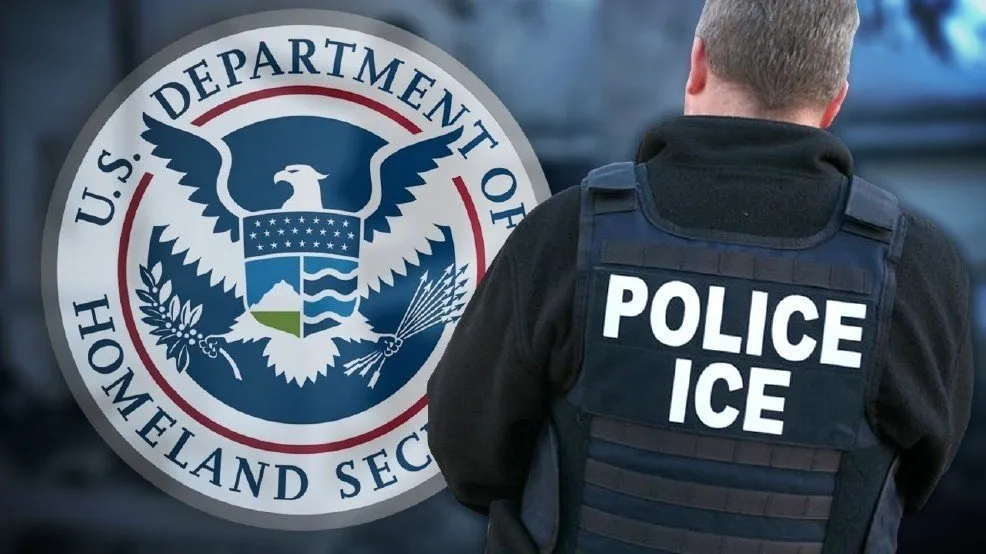
The Trump regime is suing at least six jurisdictions to keep its agents masked, and its lawyers have told federal judges why: protesters, they claim, photograph officers and run those photographs through facial-recognition tools that "search all of social media and these sites." Two sites are named in the complaints filed against New Jersey, Washington, Connecticut, Virginia, New York and Philadelphia. One is a dormant art project called ICESpy. The other is us, with our ICE List project. Neither does what the lawsuits allege, and we can prove it if ever necessary.
The New Jersey complaint, filed on 29 April, states: "Some examples of websites perpetrating the doxxing of ICE staff and contractors are ICESpy.org, ICEList.is, and ICEList.info." The same sentence, near enough, appears in the filings against Washington in May, Virginia in June, New York a fortnight later. We are, at this point, a recurring exhibit in the Department of Justice's case for why the men who kidnap people off U.S. streets should be permitted to do so with their faces covered.
It should be noted that the icelist.is and icelist.info domain names are names we have already had to stop using, despite no laws being broken by our team. U.S. government pressure alone has been enough to take them from us, the website now lives at theicelist.org, a fact any decent team of lawyers could have uncovered with minimal effort.
So let us be precise about what we are and what we do, since the Justice Department will not be. We run no facial recognition for the public, we never have, and it's doubtful we ever will. There is no tool on ICE List that lets a visitor upload a face and receive a name, which appears to be the allegation made by the U.S. government in these suits.
We post no home addresses, we publish no family members, and the site is assembled by hand by a small team and a large number of anonymous contributors. The bizarre thing to us is that websites that do paint the names, email addresses, phone numbers and family members of the U.S. public, such as Radaris, have never come under the level of attack faced by us.
When Wired analysed the database in January, and again this month, it found what anyone who reads the pages can see for themselves: our entries rest overwhelmingly on what ICE personnel posted about themselves, on LinkedIn and elsewhere, under their own names, describing their own work. Wired's own coverage was titled "ICE Agents Are Doxing Themselves", a reflection of the fact that the agents' own lack of internet privacy knowledge led us to them.
ICESpy is worse still for the Trump regime's argument. Its creator told Wired the dataset is roughly 700 LinkedIn profiles scraped in 2018, most of them lawyers and administrators, that it cannot match a working deportation officer hired in the 2025 surge, and that it drew eighty-four page views in a week. The Justice Department named both as a threat to officer safety, then, asked by Wired for a single concrete example of anyone using either to identify an agent, produced none, and put no numbers in any complaint.
We can verify the ineffectiveness of ICESpy, having come across it when we first began tracking ICE activities, and dismissing it as a useless tool for our operations. While each use of the service would lead a user to an "agent", it was never a correct match, and always linked back to an agent who had moved on from the job. For the standards we hold, this was never sufficient.
The word doing the work
The word carrying these lawsuits is "doxxing," and it is being stretched until it means the act of naming a public official at all. This is the same move the regime has run since the summer of 2025, when Kristi Noem, then running Homeland Security, told the country that "violence" against ICE now included "videotaping them where they're at when they're out on operations." Her assistant secretary, Tricia McLaughlin, went further, calling the filming and posting of federal agents doxxing and promising to prosecute "to the fullest extent of the law." The redefinition arrived first, the enforcement apparatus was then built to fit it.
Note the sequence, because it undoes the government's own case. ICE agents did not begin masking because ICE List exists. Acting director Todd Lyons defended the masks on Face the Nation on 20 July 2025, when our database held perhaps fifty names. Noem was defending them by June. The mass-scale leak the regime now cites, roughly 4,500 names sent to us by a Homeland Security whistleblower, did not arrive until January 2026, six months after the policy was set and defended. The masking came first. The justification was retrofitted, and ICE List was cast in the role. It is the same reversal we have watched the regime run in the Strait of Hormuz, where the escalation that threatens the strait is then offered as the reason the escalation was needed. They masked first and named the reason later.
What it costs to say a name
We are named in the complaints because the U.S. government has absolutely no legal footing, and they must run to scare tactics, misrepresentation and outright lies in their desperate attempt to keep their fascist foot soldiers behind masks.
Senator Marsha Blackburn wrote twice to the facial-recognition firm PimEyes, in September and November, naming our founder and calling him a "foreign" activist weaponising AI against federal officers.
Her bill, the Protecting Law Enforcement from Doxxing Act, would make it a federal crime carrying up to five years to publish the name of an immigration officer with intent to obstruct enforcement, a bill that cannot be applied to us in the EU. We highlighted at the time that this bill was written with very broad wording, as Blackburn didn't intend to target us at all. This bill was aimed at the U.S. public, something privacy experts agree with.
In October, Homeland Security issued a formal release condemning "dangerous doxxing" and citing an arrest. In January, when we were handed an enormous whistleblower leak, the Department of Homeland Security described it to the press as "4,500 felonies," these felonies again aimed at us, who do not reside in the USA.
Days later, Meta began blocking links to ICE List across Facebook, Instagram and Threads, this came in direct response to our team seeking information from the public on the ICE agent who killed Alex Pretti. Meta deciding that it was entirely okay for the U.S. regime to circulate outright lies about the innocent man on their platforms, but research into the killer was a red line.
The Federal Bureau of Investigation opened inquiries into anti-ICE messaging groups. And ICE's own Office of Professional Responsibility, the watchdog meant to investigate agents, opened, by its own court declaration, 131 cases into civilians who criticised the government online. A poll worker in Syracuse was approached by agents over an Instagram post that credited a newspaper with identifying the agent who killed Renee Good.
A senator, a bill, a cabinet department, a platform, a federal police agency, an internal-affairs office ordinarily reserved for misconduct, all turned outward, toward the people naming the officers rather than the officers doing the killing. We are named in the filings not because we endanger agents but because we are the entity that they believe they can use as a twisted excuse. The simple fact is, if we were as dangerous as the U.S. government wanted to claim, they wouldn't need to lie about it.
The most funded U.S. agency in history is on the streets killing people. The effort and time put into researching us and lying about us, should be put into investigations surrounding the endless killings. In the absence of these investigations, we are forced to assume that the killings are the plan, and under that calculated assumption, our work must continue.
Who the masks protect
The point was never our work, it is who the masks protect. Killers, kidnappers, and attackers like Jack C Ravencamp, who is now facing court for his mistreatment of the public, on the back of our identification of him.
The same government telling judges its agents are hunted online is the government whose officers shot and killed two men in Maine and Texas this month without the body cameras Congress mandated, that withheld evidence from Minnesota investigators for nearly half a year after Good and Pretti were killed, that has turned its internal watchdog on its critics.
The agent who allegedly killed a twenty-five-year-old Colombian man during a traffic stop in Maine on 13 July was identified not by any facial-recognition tool but by our hard-working team's own investigative work, along with two people who knew him and came forward, and by the reporting that followed, in which his ex-wife told the Portland Press Herald she had once warned his military superiors about his mental health.
The Trump regime refused to name him to the public, and that is always where we come in. We do not hold back these identifications, as the public deserve to know who has turned against them. Trump's Department of Homeland Security said it would "never confirm or deny attempts to dox our law enforcement officers." A man is dead, and the government's position is that the greater scandal is that people know the killer's name. This again backs up the necessity of our work, we will provide the public a service they deserve, because their government simply refuses to.
Masking is sold as safety, it functions as anonymity, and anonymity is the one condition accountability cannot survive. We run an accountability database, and won't shy away from it, no matter how often the pathetic government in Washington threaten or lie about us.
Virginia state senator Saddam Salim, whose state's unmasking law the regime has now suspended in court, put the priorities where they belong. Rather than fighting laws that ask officers to show their faces, he said, the Justice Department should pursue the corruption in front of it and release the Epstein files. We can't help but agree.