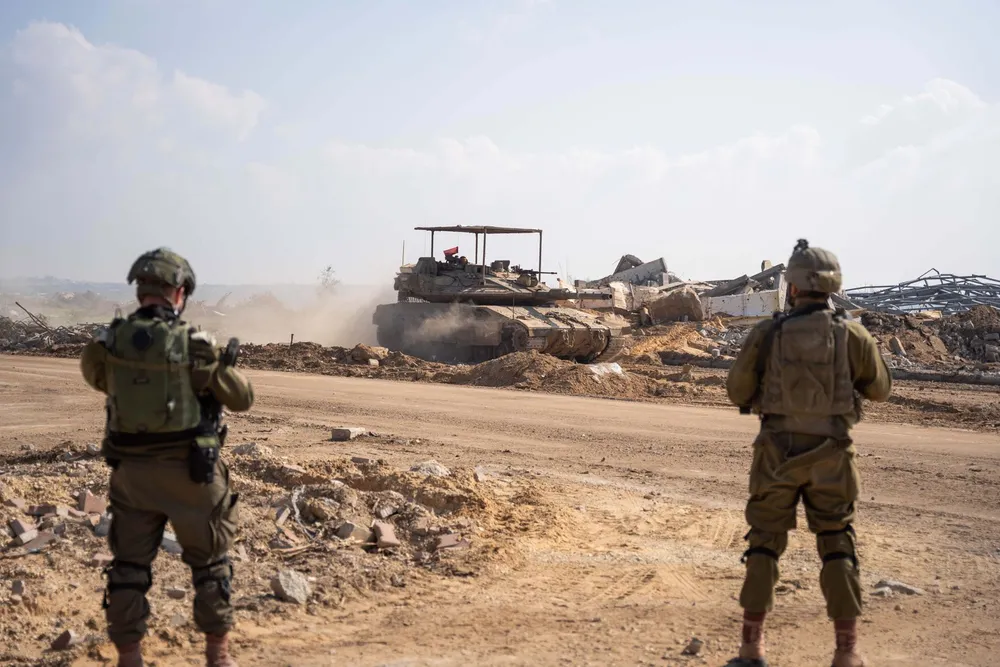
Israeli tanks crossed the yellow line into central Gaza on Wednesday, for the first time since the so-called ceasefire in October 2025. While the ceasefire was already ignored so frequently that we reported on attacks every single day, the restart of a ground offensive is harrowing news.
The invading forces reached Salah al-Din road between the Bureij and Nuseirat refugee camps, where Israeli forces killed at least three Palestinians and drove families out of their tents under shellfire. The ground operation came one week after Gadi Eisenkot, the former army chief trying to replace Benjamin Netanyahu as prime minister, warned him in writing against sending troops into battle without "a direct and immediate threat".
The Israeli military called it "a precise operation within the Gaza Strip", launched "to remove a threat posed to IDF troops operating in the Gaza Strip". As we highlighted in our own research, the IDF is now a bigger threat to the IDF than Hamas. Since the ceasefire, more Israelis have died from Israeli friendly fire, than the 4 soldiers killed in Hamas defensive operations.
Those troops occupy about two thirds of Gaza, and the army's only description of the apparent threat was "Hamas infrastructure in the area". It ordered three blocks, 660, 661 and 666, to be emptied. These are residential areas crowded with displaced families.
COGAT, the Israeli defence ministry body that administers the occupation, told residents to leave and closed Salah al-Din road, Gaza's main route from north to south. "We reserve the freedom to act and manoeuvre whenever necessary to eliminate any immediate threat in the Gaza Strip," the army said.
The order to leave arrived as the shelling started, giving residents no early warning whatsoever. "It is a tent camp. People couldn't even take their tents with them," said Ihab, 35, whose niece was in a kindergarten inside the attack area. Osama Ramzi, a father of two in Bureij, said Israeli quadcopters had been dropping explosive barrels on the east of the camp for days, the method Israeli forces used to blow up homes east of Maghazi this week.
"We fear this may be the start of a broader operation," said Mahmoud al-Saafin, 27, also of Bureij. Hamas called the operation "a flagrant violation of the ceasefire agreement", called the forced displacement a war crime, and held Israel and the United States responsible.
Israel's October election left Netanyahu without a majority, and on 8 November President Isaac Herzog gave Eisenkot 28 days to form a government after 67 members of the Knesset recommended him against 46 for Netanyahu. Netanyahu stays prime minister until Eisenkot succeeds. On 11 November Eisenkot wrote to Netanyahu asking him to hold back "dangerous actions that can wait until a new government" and warned that using the security forces without a direct and immediate threat could have "devastating consequences for Israeli democracy". He said an order sending troops into battle now would set off a constitutional conflict and that many Israelis would see it as a ploy to stay in power. On election night two weeks earlier he had said it in fewer words: "Netanyahu, don't you dare use Israel's security for your political needs."
Netanyahu's office called the letter "an irresponsible move" and accused Eisenkot of "trying to establish a government with terror supporters", its name for the Arab parties whose votes Eisenkot needs. Defence Minister Israel Katz said the government does "not need approval from the opposition or any legal authority to direct the IDF". Israeli law puts no limit on what an outgoing government can do with the army, and Netanyahu has used that before. In May 2021, as a caretaker prime minister while Yair Lapid held the mandate to replace him, he bombed Gaza for 11 days. On Wednesday Katz said Israel will hold its zones in Gaza, Lebanon and Syria indefinitely.
Gaza's Health Ministry counts 1,658 Palestinians killed by Israel during the so-called ceasefire, which took effect in October 2025, and 6,000 wounded. Gaza's Government Media Office has logged 6,233 violations by Israel, 753 of them in October alone, including 21 incursions by ground forces.
The UN human rights office verified 1,076 deaths by the end of July, 268 of them children, and found that Israel treats the yellow line as "a kill zone where lethal force is arbitrarily used". The line keeps moving. Israel held nearly 53 per cent of Gaza when the truce was announced and holds about two thirds now, on the way to the 70 per cent Netanyahu has publicly named as his goal.
Hamas agreed in July to the Board of Peace's roadmap to surrender its weapons and hand Gaza to a civilian authority. Israel rejected the roadmap, kept bombing, and paid no price for it, with no country brave enough to enact sanctions on the genocidal state.
The board, which Donald Trump chairs, sent its second report to the UN Security Council the day before the tanks moved. It split the blame between the two sides and described Israel's attacks as "strikes against Hamas targets", after 13 months in which the UN has verified hundreds of dead children.
Germany and Italy vetoed a push by Spain, Ireland and Slovenia in April to suspend the EU's trade pact with Israel, which covers 42.6 billion euros of goods a year. The European Commission has until May 2027 to answer the 1.1 million Europeans who signed a petition demanding the same suspension. The UN human rights office told states in October to stop supplying the weapons and to use their influence over Israel. Their answer so far is a report that blames both sides.
The United States brokered this ceasefire and chairs the board that oversees it, and by Wednesday evening it had said nothing about Israeli tanks crossing the line. The European Union, the UN Secretary-General and the mediators in Cairo and Doha had said nothing either. The Israeli army has not said whether it told Washington first. Israeli army sources said the pressure may be meant to force concessions from Hamas on disarmament, which is coercion, with no threat to troops in it.
Sending tanks across a ceasefire line breaks the agreement Israel signed in October 2025, and ordering civilians out of their shelters under shellfire is forcible transfer, a war crime under the Fourth Geneva Convention. Hamas has said both. No government with its name on the deal has said either, and most of the largest newsrooms in the United States and Britain had yet to report that it happened.
Tanks crossed the ceasefire line. Ten of 14 major outlets had no report.
Fourteen major outlets on Wednesday’s ground operation, checked at 17:20 GMT on 18 November. Four ran a story. None of the four headlines calls it a violation, and Reuters and AFP left that word to Hamas. We found no report from the other ten.
The New York Times
Israeli Tanks Advance Across Gaza Cease-Fire Line in Rare Incursion
Reuters
Israeli military begins a new thrust in Gaza, kills three people
AFP
Israel army launches ground operation in Hamas-controlled area of Gaza
NBC News
Israeli tanks roll into central Gaza in first ground operation since ceasefire began
AP
No report found by 17:20 GMT.
BBC
No report found by 17:20 GMT.
The Guardian
No report found by 17:20 GMT.
The Washington Post
No report found by 17:20 GMT.
The Wall Street Journal
No report found by 17:20 GMT.
CNN
No report found by 17:20 GMT.
Fox News
No report found by 17:20 GMT.
CBS News
No report found by 17:20 GMT.
ABC News
No report found by 17:20 GMT.
NPR
No report found by 17:20 GMT.
Eisenkot has until 6 December to form a government, and Netanyahu commands the army until he does. Netanyahu may be pushing for an attempt to prevent the democratic system from continuing, while bringing the height of the genocidal actions back to the streets of Gaza.