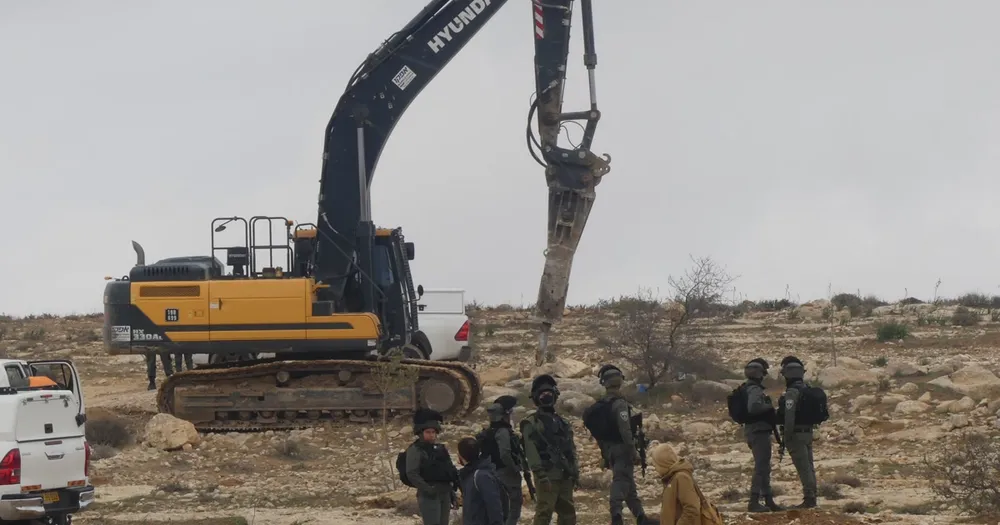
Israeli forces have issued demolition notices for two apartment buildings holding 65 flats and for a villa in north-west Hebron, all of them built with permits from the Palestinian municipality. One of the buildings stands in Area A, where the Oslo accords give planning and building powers to the Palestinian Authority alone.
The buildings hold 25 and 40 flats and stand near the traffic department and Bir al-Mahjar, overlooking the town of Beit Kahil. About 66 families live there, and some of the flats have stood for more than ten years. Israel also ordered work to stop on a family guesthouse in Farsh al-Hawa, in the west of the city.
Israel's stated reasons are that the buildings are unlicensed and that they stand close to Road 35, a road built for its settlements. Both buildings hold permits from the Hebron municipality and title deeds from the Palestinian Land Authority, said municipal council member Muammar al-Oweiwi. He said the second building stands on land that was Area A until Israel redrew the boundaries on its own and declared it Area C. Al-Oweiwi called the notices "a dangerous escalation" and said their aim is to take decisions on construction in the city away from the municipality. Hebron's mayor called them collective punishment.
The Oslo interim agreement of 1995 put civilian powers in Areas A and B, about 40% of the West Bank, in Palestinian hands, planning included. The 1997 Hebron Protocol, which Benjamin Netanyahu signed, left planning and building across the city with the Palestinian municipality, even in the part Israeli soldiers control.
The agreements are consistently cited as the framework supported on the international stage, however, the international community has been entirely silent on the latest violation by Israel.
Israel's security cabinet began taking those powers back in February. One decision let Israel's Civil Administration enforce its rules on water, the environment and archaeology inside Areas A and B. A second said Israel would take over planning and building in parts of Hebron and around Rachel's Tomb in Bethlehem. On 10 June Israel's planning council for the occupied West Bank stripped the Hebron municipality of planning powers over the settlements in the city centre and eight religious sites. Finance Minister Bezalel Smotrich called it "the cancellation of the Hebron Agreement". Israel's foreign ministry denied that.
Those decisions covered settlements and holy sites. This week's notices reach ordinary Palestinian homes that a Palestinian authority licensed, on land Israel agreed it would not administer.
Hebron has been under Israeli punishment since 22 October, when two Israeli soldiers were killed in Farsh al-Hawa. Netanyahu promised to destroy the neighbourhood the attackers came from, and Israeli forces drove 3,189 Palestinians from their homes before pulling out on 2 November.
Israel has issued at least 9,518 demolition and stop-work notices against Palestinian buildings in the West Bank since 2015, and 2,697 of them were in Hebron.