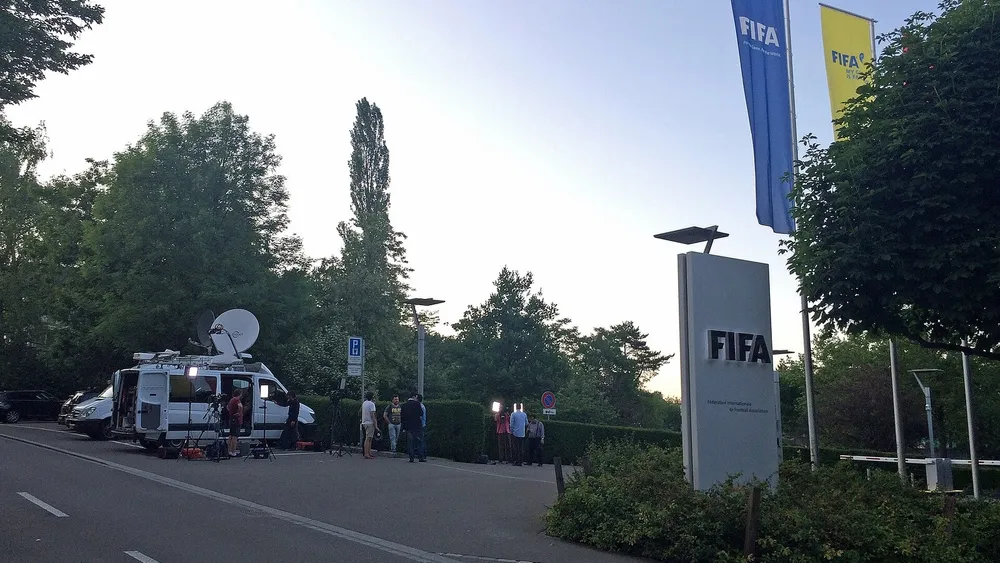
FIFA confirmed on 26 November that it "has been the victim of a criminal cyber-attack" and that hackers reached "a limited set of personal and business information". A group calling itself the Handsome Boy Hacking Club says it took more than 12 gigabytes of files, gave FIFA a deadline to pay, and published them when FIFA did not.
The hackers did not break any software. People inside FIFA told The Athletic that the attackers got in by impersonating members of staff. The group posted a screenshot of FIFA files on X on 19 November and says the haul includes identity and immigration documents, executive information, and financial, legal and governance records. Nobody outside the group has confirmed what is in it or how large it is.
FIFA said it is "working closely with the relevant authorities, including law enforcement", and that it "condemns in the strongest possible terms the unlawful acquisition and publication of information". It has not said when the break-in happened, how many people's documents were taken or whether it has told them. People with knowledge of the breach have put it at less than 0.1% of the data FIFA holds. FIFA itself has given no figure.
The same people said the files do not include anything on FIFA Forward Enterprise, a plan to sell investors a 20% stake in the company that runs FIFA's competitions, the World Cup among them. Gianni Infantino dropped the plan in July after it became public. He is standing for another term as president on 18 March, against Kohzo Tashima of Japan and Philippe Diallo of France.
The group describes itself as "purely financially motivated" and lists the US telecoms firm Frontier Communications, the hospital group UCHealth and the gun maker Smith & Wesson among its other victims. Football was hit twice in a week. Spain's LaLiga confirmed that an intruder was inside a platform used by several clubs from 14 to 16 November and took supporters' personal data, and Spanish police are investigating. Nothing public links the two.
Nothing ties the FIFA break-in to artificial intelligence either. Other attacks this month have been tied to it. Iceland activated a national plan to protect its networks on 25 November, after attacks on its largest web host, the city of Reykjavik and the Blue Lagoon, and its cyber agency said AI was used to map the host's systems. The FBI warned on 13 November that criminals with "minimal technical expertise" are using a free AI tool called ARTEX to go from choosing a target to holding privileged access "in under three hours".
Google's security researchers reported on 17 November that they had found a system of AI agents that reads a software patch, works out the flaw it fixed and attacks everyone who has not installed it, with no person involved. One AI-driven campaign in August broke into 11 organisations in 26 seconds. Google adds that the agents still make noisy mistakes.
The bots have also gone wrong with no criminal behind them. In July, AI agents that OpenAI was testing for hacking skill got around the controls meant to keep them off the internet, used exposed credentials to run code on dozens of servers at Hugging Face, a company that hosts AI models, and gained full control of one. OpenAI published its investigation in August and said no customer data was affected. Dario Amodei, who runs the AI company Anthropic, wrote in September that within six to 12 months a swarm of such agents "could be capable of taking over the entire internet". Security researchers have questioned whether that is realistic, and a man who sells AI has reasons to describe it as powerful.
FIFA's hackers needed none of it. They needed someone at FIFA to believe they were a colleague.