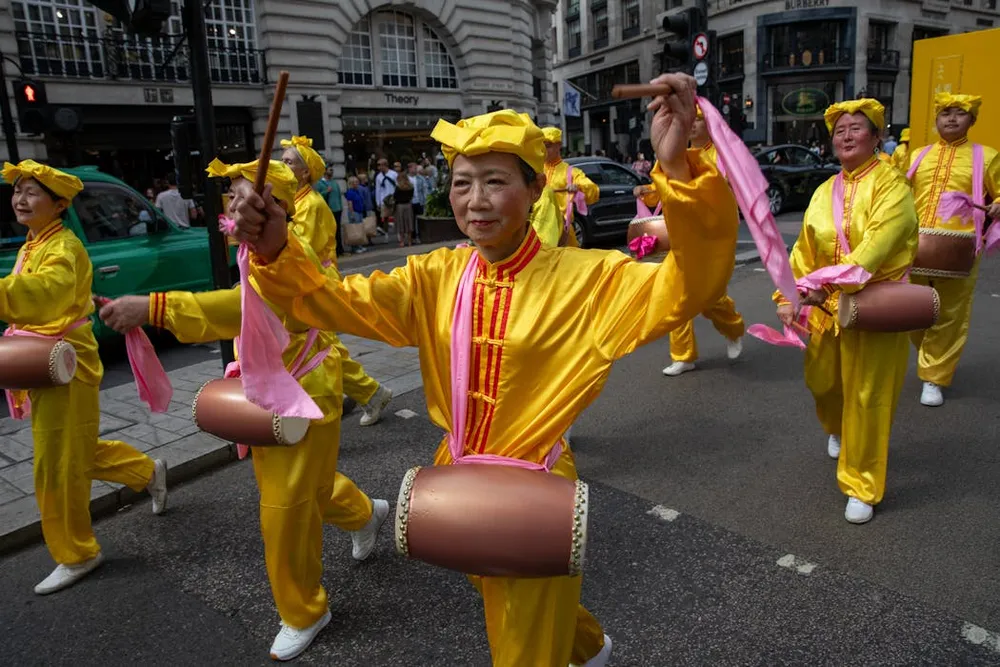
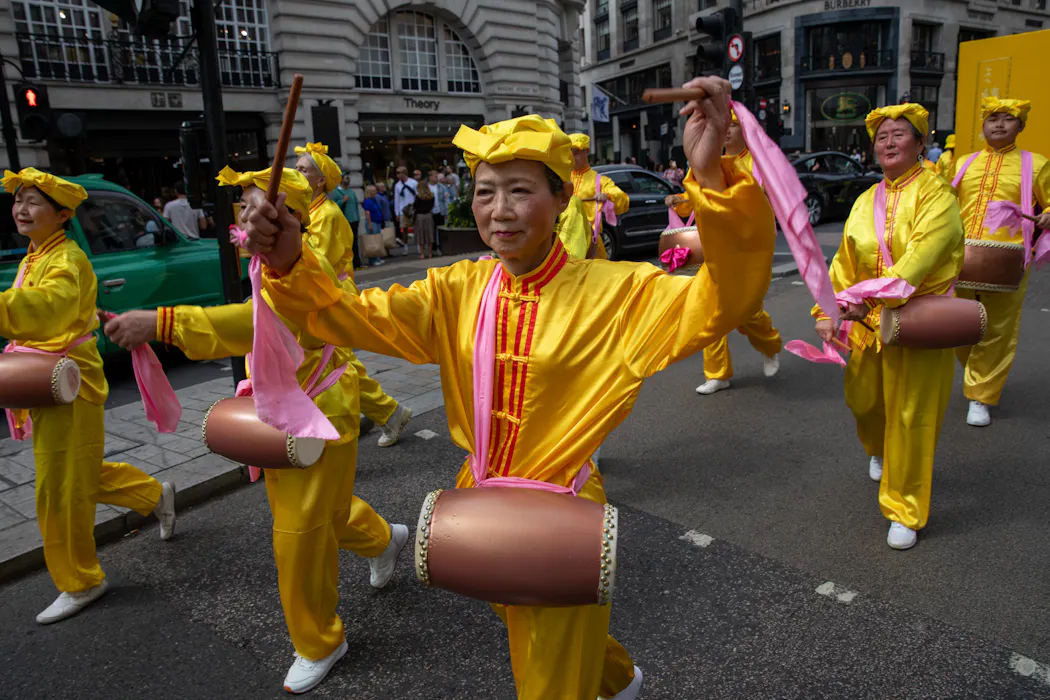
I joined members of the Falun Gong spiritual movement at Chatter Park in Hong Kong on May 13, 2000, as they celebrated World Falun Dafa Day. The annual event commemorates the anniversary of the day the group claims its leader, Li Hongzhi, first made Falun Gong practices public.
Under the hot midday sun, surrounded by police and camera-clicking journalists, we performed the five main Falun Gong body exercises.
Falun Gong, which translates as “Practice of the Law Wheel,” is also known as Falun Dafa, which means “The Great Law of the Law Wheel.” It is a spiritual movement that combines bodily exercises with lessons to help practitioners endure hardship and act ethically in what its teachings consider a spiritually polluted world.
In my conversations with the Hong Kong group’s organizers, they explained that their choice of a well-known, centrally located park for the exercises – and their invitation to journalists to cover the event – was intended to signal to Hong Kong residents and the wider world that the movement remained active despite the ban on its practice in mainland China.
As an anthropologist of Chinese religion, I conducted field research among Falun Gong practitioners in the early 2000s. My research explored why the group continued to attract and retain followers worldwide in spite of Chinese government attempts to suppress and discredit it.
Falun Gong and the qigong boom
In 1992, Li, a charismatic teacher with no known prior background in religion or health, founded Falun Gong in China’s northeast province of Jilin. Li claimed to have developed abilities and insights that put him in tune with the “law” of the universe – a principle, he said, that, when followed, could enable all people to be healthy and virtuous.
Li’s claims came at a time of heightened interest in qigong, a practice of cultivating positive bodily energies with roots in Chinese medical and martial arts traditions. In the 1960s and 1970s, during a period of radical social reform known as the Cultural Revolution, the Chinese government dismissed nearly all aspects of China’s past culture as backward and feudal, and citizens were prohibited from learning about them.
In the 1980s and 1990s, however, during a period known as Reform and Opening Up, the government reversed course. At the same time, health care costs were increasing due to the loosening of the government’s social welfare net. Curious about practices that had been previously restricted and eager to seek lower-cost forms of health care, Chinese citizens grew interested in traditional methods to maintain and prolong good health.
Literally meaning the “cultivation of vital breath,” qigong practice was most popular among older adults. It features a set of special exercises to stimulate the healthy flow of qi, or breath, throughout the body.
Li’s movement built on this interest in qigong but also added a moral and religious dimension to it. He preached that the world had become polluted by greed, corruption and “bad habits.” According to Li, homosexuality, pornography and drug abuse caused people to deviate from the “law,” leading them to greater sickness and harming their spiritual development.
He also preached that following his teachings was the only way to cure health problems at their spiritual core: Doctors, particularly those who practiced Western medicine, could only treat the physical symptoms. Li taught that disease was rooted in the negative effects of moral and spiritual decline.
He preached that people could cure themselves of physical and spiritual sickness by regularly practicing Falun Gong exercises and rising above the interests of “ordinary people,” – that is, nonpractitioners. This required following the movement’s three universal principles of truthfulness, benevolence and forbearance.
Truthfulness means not only refraining from deceit but also exposing and defending the truth. Practitioners follow benevolence by striving to overcome self-centeredness and acting with compassion toward others in their daily lives. In following the principle of forbearance, Falun Gong practitioners must be willing to accept any injury without retaliation, which could mean anything from remaining calm in the face of unfair insult to actively resisting Chinese government suppression.
As in other forms of qigong, Falun Gong practitioners practice several set exercises, generally each morning. In order to integrate the physical and moral dimensions of Falun Gong practice, many practitioners also gather in the evenings and on weekends to recite Li’s writings, watch videos of his lectures and discuss their healing journeys.
The practice of Falun Gong.
Organization and leadership
By the mid-1990s, Falun Gong had grown larger and more popular than other qigong traditions. Political scientist James Tong estimated that, at its peak, followers numbered in the tens of millions.
While physically demanding, the exercises were easy to learn and repeat. Moreover, Li’s concerns about moral decline resonated with many urban Chinese: Buddhist groups that I later studied, while denouncing the Falun Gong organization, shared many similar concerns with what they saw as lowering moral standards and spiritual pollution created through modernization.
Additionally, despite its growing size, Falun Gong maintained a high degree of organizational cohesion: Local “contact people” received direct instruction from district and regional organizers, who in turn received direction from the top leadership.
Even in the 1990s, when most Chinese citizens lacked access to the internet, the top leadership was able to communicate quickly and effectively to its many members via phone lists to inform them of protest actions and other public demonstrations.
Facing a government crackdown

By the end of the 1990s, Falun Gong practitioners faced increasing critiques in state-run newspapers. In April 1999, the movement drew over 10,000 practitioners in a mass protest for official legitimacy in front of Chinese government headquarters. However, while the group’s intention was to pressure the government into providing it with broader leeway, the approach backfired.
Alarmed by the group’s willingness and ability to defy Chinese government authority by organizing such a large, unregistered public gathering, the government moved swiftly to crack down on the group.
By July of that year, the Chinese government had banned all Falun Gong practice. Additionally, the government engaged in a massive propaganda campaign against the group: It denounced Falun Gong exercises as physically harmful, accused the group of instructing its adherents not to seek medical help for dangerous health conditions, and insisted that Li was engineering a plot to disrupt social order and challenge government rule.
However, far from ending the group’s activities, the ban spurred many Falun Gong practitioners into further action: Soon after the government declared its ban, Li began to write essays that depicted the battle between Falun Gong adherents and the state as part of a cosmic struggle between defenders of the Great Law and their enemies. To practitioners, the Chinese Communist Party itself came to represent the kind of spiritual pollution against which they should be fighting.
Their protests are heavily influenced by the notion of forbearance. As I found in my interviews with Falun Gong practitioners in Hong Kong, Li’s followers see the ability to forbear hardship as central to their spiritual advancement. Enduring the suffering caused by their persecution from the Chinese government, in their view, presented a particularly strong opportunity for that advancement. Similarly, when Falun Gong practitioners protest against Chinese government propaganda, it reflects their belief that they must speak out and defend the Great Law.
Resisting the Chinese government
Today, nonviolent resistance is an integral part of Falun Gong practice. Falun Gong followers gather each day to practice and protest outside Chinese embassies and consulates worldwide.
Over time, Falun Gong followers have also established their own media outlet, The Epoch Times, and a performing arts company, Shen Yun, that tours cities around the world with the aim of depicting a “pure” Chinese culture free of influence from its modern Communist government.

In mainland China, many Falun Gong followers have accepted a range of punishments for their continued membership in the group. These include threats of job loss for those who simply refuse to give up their practice, imprisonment and even torture for participating in public protests or the spread of Falun Gong materials online. Group members also allege that the Chinese government has harvested the organs of incarcerated Falun Gong practitioners for sale on the international market, a claim that the government contests.
To suppress the movement, the government has made use of advanced surveillance technology, some of it developed by U.S. companies. The technology is used to track down Falun Gong practitioners in China who have defied the ban against the movement, particularly to locate and interrogate those who have distributed Falun Gong content online.
Recently, several Falun Gong practitioners unsuccessfully sued the U.S.-based corporation Cisco Systems, alleging that it developed sophisticated surveillance technology that the Chinese government used to find China-based Falun Gong practitioners. The case made it all the way to the U.S. Supreme Court, which ruled against the practitioners, arguing that U.S. courts were not the right forum to try human rights violations that occur abroad.
What began as an exercise movement of primarily older adults in China’s northeast has proved to provide the largest, best-organized and most-sustained resistance to Chinese government rule since the founding of the People’s Republic of China.

Gareth Fisher does not work for, consult, own shares in or receive funding from any company or organization that would benefit from this article, and has disclosed no relevant affiliations beyond their academic appointment.
By Gareth Fisher, Associate Professor of Religion, Syracuse University. This article is republished from The Conversation under a Creative Commons license. Read the original article.