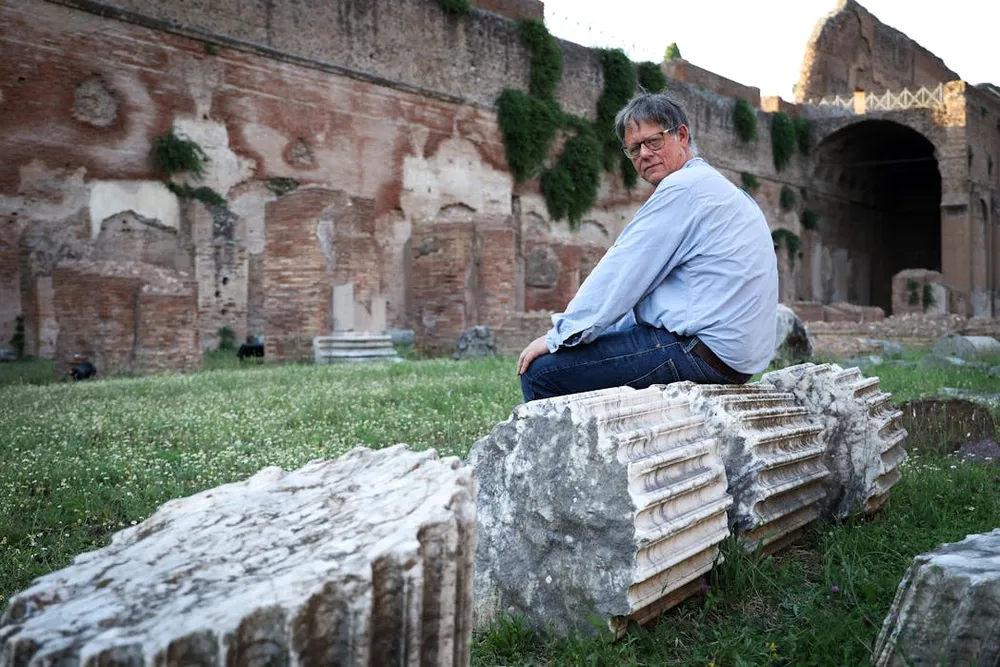
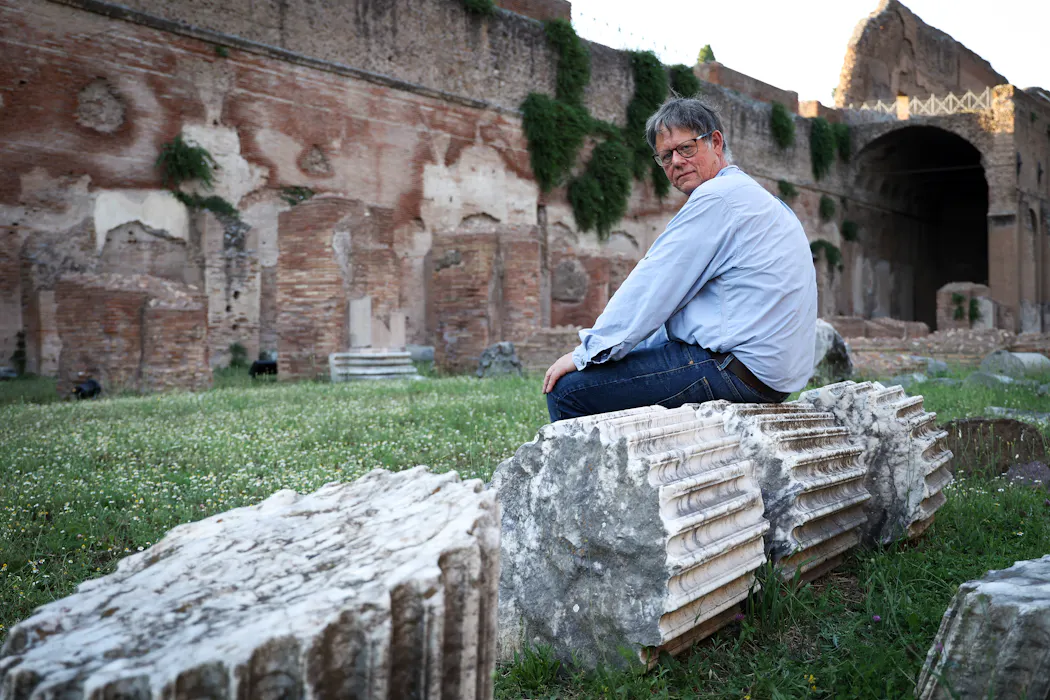
With forecasters of doom debating the end of reading, of publishing and of literacy in general, what should we make of William T. Vollmann’s forthcoming novel, “A Table for Fortune”?
Spanning four volumes at 3,000 pages, is it madness? A determined attempt to silence print’s naysayers?
I have been writing about Vollmann’s works since I penned the introduction to “William T. Vollmann: A Critical Companion” more than 10 years ago.
The 67-year-old author has spent his career going big, in every sense, and I would not be the first to describe his approach to his art as uncompromising.
His projects grapple with weighty matters such as global poverty, the history of North America and climate change. Few of his roughly 25 books run under 500 pages. About half try to keep his readers engaged for several hundred beyond that. Many of them supplement the text with photographs, epigraphs, glossaries, family trees, sketches, timelines, variant tables of contents, alternating fonts and notes to the reader. The essay “Rising Up and Rising Down,” his philosophical and journalistic inquiry into the nature of violence, clocks in at over 3,000 pages across seven volumes.
But to those who might argue that this is the worst time to put a monster of a novel into print since the days before Johannes Gutenberg created the movable-type printing press in the 15th century, I would say that Vollmann’s approach is needed now more than ever.
The ‘poisoned harvest’ of 9/11
After reading Vollmann’s works and occasionally speaking with him in person or via post, I join others in being powerfully struck by his unrivaled intelligence, empathy and work ethic. His books are not big for the sake of being big. They reflect the deep sense of responsibility he feels toward his subjects.
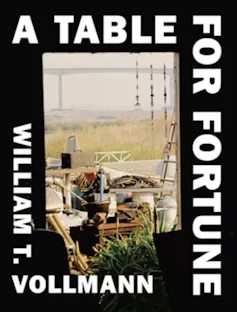
In the case of “A Table for Fortune,” that subject is, as Vollmann declares in the opening volume, the cause and effects of 9/11 – “tracing the roots of that crime in one direction and its poisoned harvest in another.”
It is a novel of ideas and a novel of feelings, the former expressed in the tale of a CIA man who bears the code name DAVE, and the latter the purview of his son, Matthew. DAVE is a brilliant, deeply committed Cold War analyst whose faith in America’s mission gradually erodes after 9/11 and the ensuing war on terror. Matthew, by contrast, is less interested in geopolitics but just as invested in questions about the nature of America. His desire for purpose in life is deeply informed by a notion that the nation still harbors opportunities for freedom. At the same time, his search for that freedom leads him into such dangers as homelessness and addiction.
The book will be published at a challenging moment for Vollmann — and for reading more broadly.
In 2022 alone, he lost his daughter, was dropped by Viking, his longtime publisher, and the supporters of his archives at Ohio State, and got hit by a car while crossing a street. He has also been fighting an incurable case of colon cancer, racing against the clock to see a few final projects to completion.
Meanwhile, the nation’s educational system is constantly having to calibrate its expectations for reading down, and publishers find themselves confronting steadily worsening odds that the average reader will even pick up a book in the next year.
To the extent that there is a reading public, they’re assumed to be increasingly ill-equipped to handle the very sorts of things that motivated Viking to drop Vollmann: His books seem too long, too complex and too expensive to publish.
Deep dives can confront shallow duplicity
But I think the apparent gulf between Vollmann’s work and America’s dismal reading data could be thought of differently. What if the challenging complexity and political engagement of his tomes are exactly what’s needed?
Today, fact and fantasy intermingle freely as a consequence of political scheming and jockeying for economic advantage. Political discourse is reduced to opinions at once homogenous and balkanized, reinforced by the echo chambers of the day’s regnant algorithms. Then there are the fragmented attention spans birthed by our dearly beloved screens, which cultivate a kind of cognitive whiplash that vacillates between amnesia and yearning for more.
It’s easy to become dispirited and cynical: The field seems too big, and the game rewrites the rules too quickly for anyone to figure out how to overcome these forces.
Maybe the first step is recognition.
What happens, Vollmann’s works ask, when serving the good is revealed as its opposite? What happens when the response to the horror of 9/11 becomes an arena for perpetration of further crimes, rather than the healing of wounds already inflicted?
Even as the invasion of Afghanistan in 2001 and of Iraq in 2003 became largely condoned by the American public, displacement, suffering and impasse persist in the region, now in the form of the ongoing conflicts in the Gaza Strip and Iran. The broader post-9/11 strategy seems directed against stable governance in the Middle East generally.
Whether one works for the CIA – as do several of Vollmann’s central characters in “A Table for Fortune” – or occupies a less central node in the networks of power, it is not hard to recognize that the best intentions can be perverted, that one’s idealistic labor may unknowingly be lent to furthering the cloaked ambitions of the wicked.
Such legacies of 9/11 are the sort of uncomfortable and powerful matters to which Vollmann directs attention. And if people are to grapple with such thorny topics, they need to be delineated in detail and at length, as they are in “A Table for Fortune.”
A work like this is not only a book about powerful conspirators. It is also a book that can help keep people afloat as they navigate the tumultuous seas of the post-truth era, dodge the whirlpools of digital banality and resist the leviathans of techno-capitalism.
Literary life rafts
Vollmann is not going it alone. Far from it.
He follows the tradition of what scholars call “literary maximalism” – works that are ambitious in scale and scope, containing narratives flush with surprising intersections, proliferations and divergences.
His works build on such earlier mega-novels as Thomas Pynchon’s “Gravity’s Rainbow,” William Gaddis’ “The Recognitions” and John Barth’s “The Sot-Weed Factor,” which together confront the complexities of America’s past and present. Their topics include the limits of authenticity and how to grasp understanding in a world awash in deceit.

Vollmann also joins ambitious contemporaries such as David Foster Wallace, whose “Infinite Jest” interrogates the loss of self to entertainment and the vapid slogans of popular culture.
Behind each is arguably the grandest American novel of all, “Moby-Dick.”
I was not surprised to learn that Vollmann visited Polynesia in 2019 to walk in Herman Melville’s footsteps. Melville, after all, was wracked by difficulties that should never have been his to bear: constant problems with publishers, uncomprehending reviews, endlessly faltering finances and the loss of a teenage son to a self-inflicted gunshot wound that may not have been an accident.
In other words, Vollmann’s work is not entirely an outlier. Neither is his readership.
Indie publishing houses like Deep Vellum are celebrating thick books, and not just those from American authors. Mircea Cărtărescu’s 2015 “Solenoid,” which begins with a fictional biography set in Cold War Romania, has earned a dedicated following in translation. Michael Lentz’s “Schattenfroh,” a 1,001-page novel that follows the internal narrative of a tortured subject confronting centuries of history, likewise garnered considerable attention when its English translation dropped in 2025.
In his note to the reader, Vollmann explains that the ongoing failures most strikingly signaled by 9/11 are matters of “lessons not learned,” “expediencies of power” and “consciences disabled,” in addition to that most cunning arbiter: “chance.”
The same list of conditions is relevant to the debates about our faltering literacy. If, as seems likely, “A Table for Fortune” is one of Vollmann’s final books, it crowns a career that reminds readers that the world’s troubles must be apprehended as much more complex than a few data points and alarmist sound bites suggest.
Indeed, books like “A Table for Fortune” may be among the most essential tools for keeping our heads above water.

Christopher Coffman does not work for, consult, own shares in or receive funding from any company or organization that would benefit from this article, and has disclosed no relevant affiliations beyond their academic appointment.
By Christopher Coffman, Master Lecturer in Humanities, Boston University. This article is republished from The Conversation under a Creative Commons license. Read the original article.