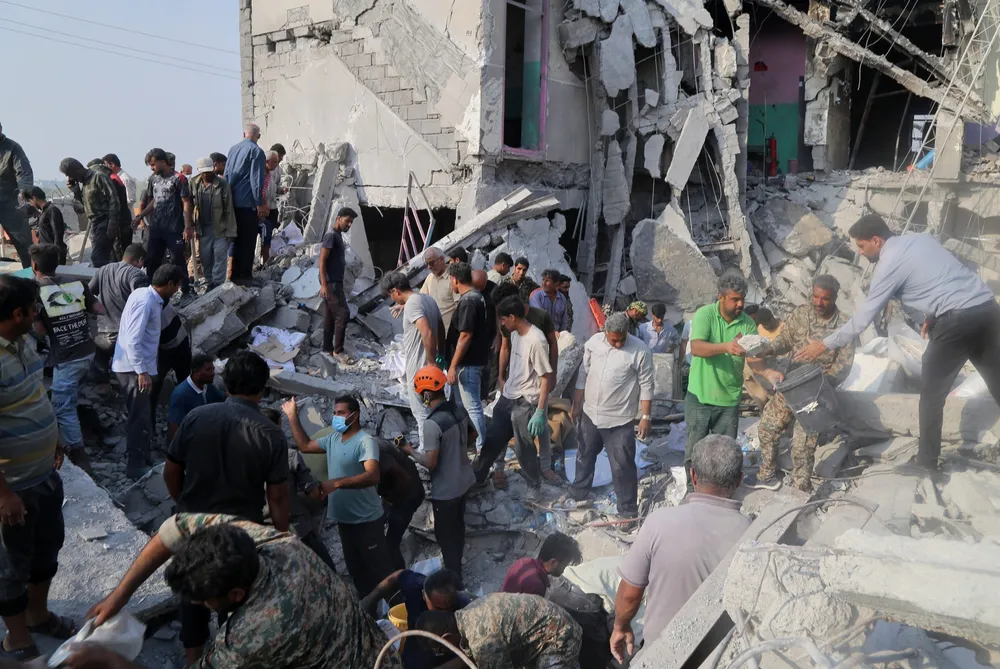
The Pentagon will not publish its investigation into the Minab school strike until after the midterm elections. Bloomberg reported on Thursday that advisers to Pete Hegseth have told staff the report stays shut until after 3 November at the earliest, that it has been all but finished for months, and that it finds the strike was built on flawed intelligence, out-of-date imagery and an overreliance on AI.
On the morning of 28 February, the first day of Trump's war on Iran, two U.S. Tomahawk missiles hit the Shajareh Tayyebeh elementary school in Minab, Hormozgan, while classes were on. The Minab prosecutor's final count is 156 dead: 120 pupils, 73 boys and 47 girls, 26 teachers, seven parents, the bus driver, a clinic technician and an unborn child. It is the deadliest single U.S. strike since 1991.
Trump's first account was that Iran did it. "In my opinion and based on what I've seen, that was done by Iran," he said in March, after footage showed a Tomahawk, a missile Iran does not have. Within two weeks the New York Times had the preliminary finding: U.S. Central Command fired on coordinates from a Defense Intelligence Agency database that still listed the school as part of the Revolutionary Guard compound next door, which it had been walled off from a decade earlier. Hegseth announced a command investigation. By June Trump had moved to "Mistakes are made. War is nasty," and "Nobody did that on purpose."
Then the investigation stopped moving. In May the CENTCOM commander, Admiral Brad Cooper, called it "complex" and promised the findings would be public when it was done. In July CNN reported that the standard intelligence review had never been ordered, and quoted an official: "There was no detailed analysis conducted, and CENTCOM locked down the investigation, blocked anyone from looking into it." In September the UN's fact-finding mission on Iran found "reasonable grounds" to believe the United States had committed a war crime at Minab, that the school was "clearly identifiable", and that the failure to update the targeting database "went beyond mere negligence". The State Department said it did not consider the report credible.
Six Democratic senators demanded in March that the Pentagon explain "how the strike happened and why"; Kirsten Gillibrand and Elissa Slotkin wrote again in July. Thomas Massie's resolution to impeach Hegseth, filed in September, notes that the school was hit after Hegseth moved to repeal the military's civilian-protection requirements. None of them has had an answer, and now none of them will have one before voters do.
We wrote in March that the USA and Israel could not stop committing war crimes in Iran. The Minab finding was the one case the Pentagon admitted it was examining. Hegseth has read it, decided what it says, and decided that the public will hear it after the election rather than before. One hundred and twenty children were killed by an American missile on a database nobody had checked in ten years, and the Secretary of Defense's response to the finished report is a calendar.




.jpg)