

Why do disagreements about vaccines, climate change or elections often feel so personal? Our research suggests it is not simply because other people have different beliefs. It is because we think those beliefs are mistaken.
We are behavioral scientists who study the role of beliefs in politics and everyday life. Our new research finds that people are more disturbed by others’ beliefs when they feel those beliefs are not merely different from their own but are based on incorrect information.
For example, two people may disagree about the ideal level of immigration, but if one believes immigrants commit more crime than U.S.-born residents and the other is convinced the statistics show otherwise, their disagreement becomes a conflict over reality and truth.
That distinction matters because public debate over polarization often starts with a simple idea: People prefer others who think like them – “birds of a feather flock together,” as the saying goes. Social scientists call this belief homophily, and many researchers have studied how these shared beliefs shape friendships, neighborhoods, media habits and political life.
The idea has strong intuitive appeal: People often live near others who share their politics. People also tend to consume news and social media that fit their existing views, a pattern linked to echo chambers and political polarization.
Our research, based on four studies with more than 2,000 U.S. adults, suggests that the story that we and others have formulated is incomplete. People do not react the same way to all disagreements: They are especially bothered when they are convinced that someone is wrong.
Wrong beliefs fuel avoidance
In one study, we asked participants to recall a situation in which another person believed one thing and they believed something else. Some participants described a situation involving different beliefs, while others recalled one with incorrect beliefs. For example, one participant recalled a disagreement about whether couples should live together before marriage, viewing it as a difference in priorities rather than a dispute over reality. By contrast, another participant recalled disagreeing with a friend who believed drinking soda and eating fast food was harmless, a belief the participant considered factually wrong.
Their emotional reactions were dramatically different: Participants who saw the other person’s belief as incorrect reported having felt more disturbed, frustrated and upset than participants who saw the belief as simply different.
In another study, participants first reported their views on divisive topics, such as climate change, capital punishment and policing. Then they saw a hypothetical social media post that opposed their view. The more confident participants were that the author’s belief was incorrect, the more disturbed they felt. They also said they would be more likely to avoid, distrust or block that person. By contrast, being confident that the other person’s belief was simply different – not wrong – did not predict avoidance.
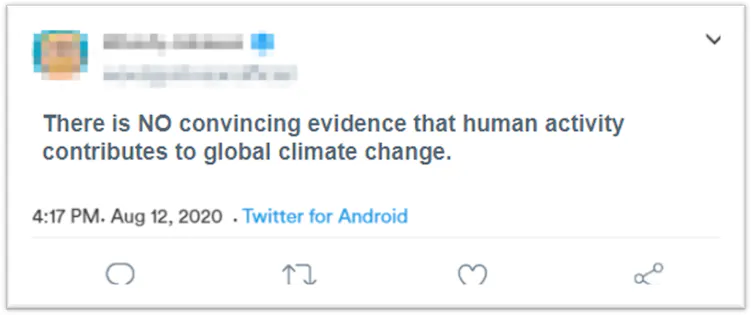
Finally, we gave participants short fictional stories – for example, about a neighbor who believed that a politician was corrupt. All participants read the same basic facts. The only change was how we framed the other person’s beliefs.
We told participants that their fictional neighbor had either different beliefs or incorrect beliefs about the politician’s alleged corruption. Though they were given the same information, people were substantially more disturbed when the other person’s belief was framed as incorrect.
Why false beliefs make people frustrated
Our studies point to several possible reasons for why false beliefs feel so upsetting. One is consequences.
False beliefs can often lead to bad decisions. For example, someone’s incorrect beliefs about vaccines or climate change can affect not only us, personally, but also other people we care about, including, in some cases, the person holding the seemingly false belief.
A second possibility is that false beliefs threaten people’s sense of shared reality. People rely on others to make sense of the world. When someone appears to deny what feels obvious or true, the conflict can feel more disturbing than merely having different perspectives.
A third possibility is that people treat false beliefs as signals about the person holding them. When we are convinced that someone is wrong, we may conclude that they are biased or irrational. Psychologists have described this as a sign of naive realism, the belief that we see the world objectively, while those who disagree with us are distorted by bias or self-interest. That kind of judgment can make a false belief feel socially threatening.
Difference may still matter for close relationships
Our findings do not mean that people are indifferent to differences.
In our social media study, participants were less able to imagine having close relationships, such as family or romantic relationships, with someone whose beliefs differed from theirs, even if they did not consider those beliefs to be false. Shared beliefs and values may matter more when people think about spouses, relatives or close friends than when they think about neighbors, colleagues or strangers online.
But for less intimate relationships, the perception of wrongness was the key predictor of negative feelings and avoidance. People did not want to avoid those who disagreed with them; they wanted to avoid those they believed were mistaken.
This helps explain why some debates become so emotionally intense, especially online. A disagreement about taste or sports may stay harmless, but a disagreement about vaccines, climate change or election integrity can feel different because people often see one side as factually wrong and potentially harmful.
The paradox of fact-based debate
Public discussions often call for more fact-based debate, but we believe such a drive for hard truths may be counterproductive. Facts matter, and empirical evidence should guide debates, but our findings suggest a paradox: When people use facts to defend their preferences, tastes or values, they may turn a disagreement over priorities into a dispute over who is right and who is wrong, potentially turning up the emotional heat.
That shift can make disagreement harder to tolerate. A person can “agree to disagree” about which school policy reflects the right priorities or which candidate best represents their values. It is much harder to agree to disagree when facts are at issue. The nastiness of intellectual disputes, therefore, depends in part on how people frame their positions. Even if the contents of the disagreement are the same, it is very different to say “we disagree” than to say that “you are wrong.”

The authors do not work for, consult, own shares in or receive funding from any company or organization that would benefit from this article, and have disclosed no relevant affiliations beyond their academic appointment.
By Andras Molnar, Assistant Professor of Psychology, University of Michigan, George Loewenstein, Professor of Economics and Psychology, Carnegie Mellon University. This article is republished from The Conversation under a Creative Commons license. Read the original article.