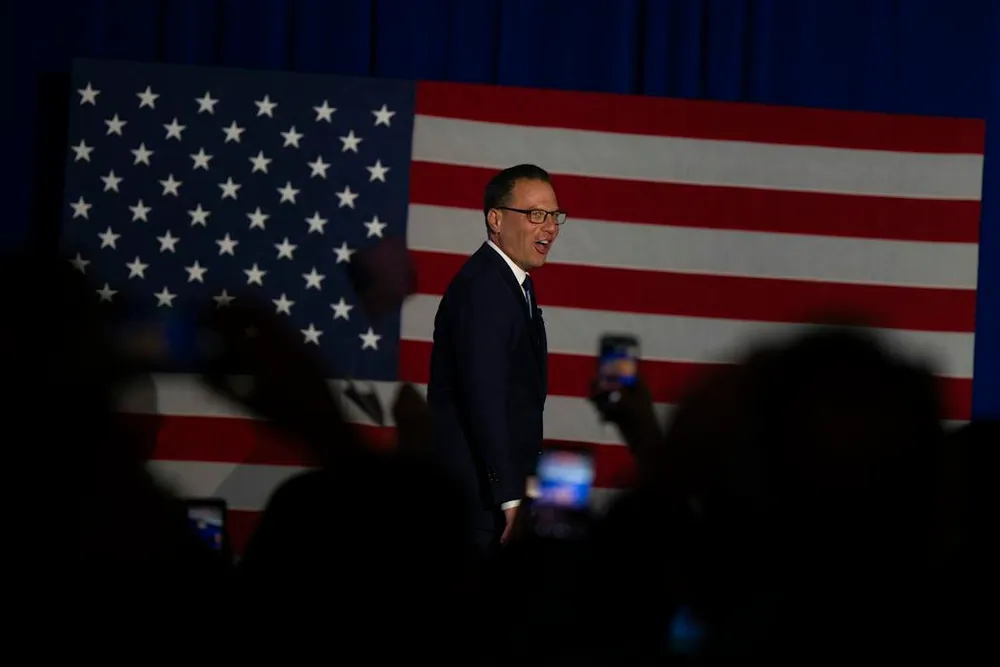

The 2026 midterm elections swept Democrats into office around the country in such numbers that journalists were running out of synonyms for “massive.”
In Pennsylvania, Gov. Josh Shapiro won reelection by 22 percentage points, winning more than 60% of the vote – something that has been accomplished only twice before in the modern era in the Keystone State.
Not only did Shapiro wipe the floor with his opponent Stacy Garrity, the state treasurer, but he also helped flip four U.S. House seats from red to blue. His coattails benefited down-ballot candidates, helping Democrats solidify their control of the state House and flip the state Senate as well.
Shapiro’s political stock in Pennsylvania is riding high.
I’m a political science professor and political media researcher in central Pennsylvania, and many of my former students work in Harrisburg. Some are Democrats working for or around the governor; others are Republicans working in different corners of state government. All are finely tuned to the political gossip that swirls around a successful politician whose star is on the rise. It is the worst-kept secret in American politics that Josh Shapiro wants to be president.
I’ve met the governor a handful of times and can attest to his George Clooney-level charisma. He’s a hard worker, has maintained a remarkably clean political profile, and is from many accounts a genuinely nice dude.
And yet, there are plenty of reasons his ambitions may require some careful timing, regardless of his personal strengths.
A reputation for getting stuff done
Shapiro’s political victories didn’t just happen. Over the past four years, he has worked to demonstrate bipartisan competence as Pennsylvania’s chief executive, adopting an expression he uses frequently: “get sh-t done.”
Now, with Democrats holding the governor’s office and both chambers of the General Assembly, Shapiro told reporters: “We got the power now, the House, the Senate. We have to deliver.”
Shapiro’s approval ratings have remained strong, consistent with his reelection margins. That’s unusual in a state that has swung back and forth between supporting Donald Trump in 2016, Joe Biden in 2020 and Trump again in 2024, each time by fewer than 2 percentage points.
If Shapiro is indeed seriously eyeing the White House, his current popularity will certainly serve him well. But winning the presidency is an enormous undertaking, particularly in a crowded field.

Stiff competition in 2028
With Trump unable to run in 2028, the next presidential election will feature open seats for both parties and likely attract many candidates. Democrats, in particular, have a deep bench of attractive potential contenders.
There are so many possibilities that Shapiro could find himself running against people very much like him: younger centrists, swing-state politicians and accomplished elected officials with solid records. Consider just a few names that could be part of the conversation: Georgia Sen. Jon Ossoff, Illinois Gov. JB Pritzker and former Chicago Mayor Rahm Emanuel.
Shapiro would have to find a way to distinguish himself in a field filled with candidates who can make many of the same arguments about their experience, political appeal and accomplishments. That’s a tall order. A Plan B might be wise.
Options beyond the White House
Fortunately for Shapiro, other choices abound.
He could run for the Senate in 2028 against incumbent John Fetterman, if Fetterman seeks reelection. This would be a twofer: Shapiro would continue his rise in politics, and he would likely beat a guy he apparently does not like. The two reportedly don’t speak, much less get along.
Shapiro could also position himself for a vice presidential nomination by attaching himself to another 2028 hopeful. This would buy him time to build his national profile, allow the presidential field to sort itself out and potentially put him in a strong position for another run at the White House down the road. It would also give him an opportunity to demonstrate that he can work effectively on a national stage.
Or he could angle for a Cabinet post. The federal government has undergone significant restructuring under DOGE and Trump’s executive orders. Should a Democrat win the White House in 2028, rebuilding federal agencies and restoring institutional capacity will be a monumental undertaking. Shapiro could be an attractive candidate for a major administrative role.
The bottom line for Shapiro is that he will need to distinguish himself from a crowded field of Democrats by emphasizing his statewide victories in a major swing state, impressive fundraising ability and a political voice that can evoke Barack Obama without alienating either his party or the broader electorate. That’s a tricky feat, even for the most talented politicians.
But Nov. 3, 2026, showed us that he knows how to make sh-t happen. Whatever he decides, the next two years will be important for Shapiro, consequential for Democrats, and fascinating for political scientists like me, who will be watching events unfold with a keen eye and, probably, a bucket of popcorn.
Read more of our stories about Philadelphia and Pennsylvania, or sign up for our Philadelphia newsletter on Substack.

Alison Dagnes does not work for, consult, own shares in or receive funding from any company or organization that would benefit from this article, and has disclosed no relevant affiliations beyond their academic appointment.
By Alison Dagnes, Professor of Political & Social Inquiry, Shippensburg University. This article is republished from The Conversation under a Creative Commons license. Read the original article.